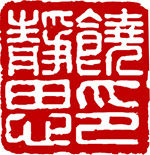
Tō no Kata (韜之形; forms of containment or concealment) refers to the study of military tactics that encircle or surround an enemy. While the character 韜 is often interpreted as referring to the leather wrapping of bamboo fukuro shinai used during contemporary practice, here we emphasize its older meaning.
In the 1800 mokuroku of Ogawa (Ogawa Yashichi (小川彌七) 1800), each entry is listed with the suffix tō (韜; tactic). Use of tō is significant, as a note in the upper margin of the same densho names the Chinese military classics, the Wúzǐ, the Sūnzǐ and the Seven Classics (呉子孫子七書), one of which is well-known to be Rikutō (六韜; Liu Tao, the Six Secret Teachings). This may be where the use of the character is derived. The set is also written 十之形, “ten forms”.
The set is late. Naganuma Kunisato added Ryūbi, Menkage, Teppa, Matsukaze, Hayafune and Kyokushaku in his kudensho of 1764; Enren is older, and already stands in Takahashi’s transmission to Yamada Ippūsai of 1679 (Karukome Yoshitaka 2020; Karukome Yoshitaka and Sakai Toshinobu 2013). By 1764 the older Shinkage canon of Enpi, Sangaku, Kuka and Tengu-shō was gone from the school’s catalogue: none of them appears in Kunisato’s kudensho. The 1800 glosses mark the boundaries themselves. Chōtan Ichimi closes the Hōjō with “up to here, the four bokutō forms”; Ryūbi opens with 是ゟシナイノ形, “from here, the shinai forms”; and Hayafune ends with 是迄十ノ形也, “up to here, ten forms”, so that Kyokushaku and Enren stand outside the ten. Ishigaki’s line regarded the whole set as later work: Nomi Teijirō’s note, which Ishigaki quotes, lists 撓十四本ノ形 (the fourteen shinai forms) with Marubashi and kodachi as made by later men and not used by Odani or Sakakibara (Ishigaki, pp. 295–296) (Ishigaki Yasuzō (石垣安造) 2001).
The mokuroku group the kata by kind, not by season. One seasonal assignment taught in the school, which can be no older than 1764, treats Hōjō as the foundational forms of Spring and presents Tō no Kata in three sections:
-
Summer (Ryūbi and Menkage)
-
Autumn (Teppa, Matsukaze, Hayafune, Kyokushaku)
-
Winter (Enren)
Typically performed using heavy shinai without tsuba, whose sakigawa (先革; leather tip covering) extends almost halfway down its length (much more so than typical in standard kendō shinai today). These are the original shinai specific to Jikishinkage-ryū and nearly impossible to procure outside of Japan.
As a substitute, some practitioners utilize Yagyū Shinkage-ryū fukuro shinai. Those implements are lighter and more flexible, and change the character of the kata when used. Kashima-Shinryū and Nen-ryū fukuro shinai with tsuba have the right dimensions and are commonly available, due to their popularity among certain kobudō (古武道; old martial ways) and aikidō groups.
An important feature of the kata listed in this mokuroku is that in their performance, both participants are learning features of Jikishinkage-ryū — Uchidachi is never simply a foil for Shidachi to learn basic movements or practices, Instead, both parties are learning complementary material. This is in contrast to some kata of other ryū, where Uchidachi models a generic swordsman — here they are also modeling the principles of Shinkage-ryū.
In classical arts that emphasize pattern practice, it is still important to test our skill. At the same time, even when testing it, we want our practice to retain the character of what it is, instead of regressing to the mean in an attempt to win at a form of competition. Some arts still do this pressure testing, but they are arduous and do not attract many practitioners. People who excel at arts of good repute might quickly fail out of that kind of training evolution, once randomness and freedom are introduced. The familiar can become unfamiliar and with freedom comes a proportionate amount of stress introduced into the practice.
It is not clear that traditional martial arts are capable of taking anyone interested in older approaches to training and culture on an intellectual level and bringing them to the correct mindset, without an external threat of conflict that would drive practice and an associated cultivation of how to keep the mind focused and relaxed during times of danger (through posture, breathing, visualization, incantation, or other means). Historically, in the case of Jikishinkage-ryū, its exponents did not shy away from pressure testing (especially the Odani-ha and Naganuma-ha), so until recently much of its approach, despite its outwardly cryptic nature, did not become stagnant.
Practices such as Hōjō and Tō no Kata were meant to prepare for and inform later free practice such as tameshi-ai (驗試合). This was informed by higher-level explanatory teachings called koto (“matters”) or katsu (克; victory) – see the section below.
Only by going through both order (in the case of kata practice) and chaos (in the case of tameshi-ai) in training can one hope to grasp the inner secrets of the sword.
Common Features
We examine a bit of the structure of Tō no Kata as a whole and the combative initiatives involved before we provide material and description of each kata in detail.
Most movements are conducted clearly and with full nagashi movements instead of smaller movements called kaitō (回刀; revolving sword). The latter would be more typical of combative application or kuzushi (崩し; lit. “breaking down” [the kata or enemy]). Also, stances often begin as deep lunges with the hips held square, the body forward weighted.
Raitō is often viewed as a strong offensive kamae. It is a variant of jōdan where the arms are stretched overhead with the tip of the sword angled behind the practitioner, parallel to the ground or inclined slightly upward overhead. It seems like it would be a position from which one could launch a powerful cut, and in fact it is. However, in Tō no Kata, we do not often see Shidachi using raitō (雷刀) or jōdan to directly engage Uchidachi.
In Tō no Kata, the first kata called Ryūbi involves stepping forward and backwards, executing continuous oblique yoko-men (横面; side of the helmet or mask) cuts, which in practice intercept the forearm if the opponent is in an upper-level posture. The next two kata, Menkage, drill similar movements with direct, downward cuts.
The third pairing, first part of a set called Teppa, involves waiting in jōdan and cutting with kesa-giri down to the left or the right, with associated footwork against an upper-level thrust to the eyes or slicing cut to the side of the neck.
In the second half of Teppa, Matsukaze, and Hayafune (six of the kata in the set as a whole) Shidachi advances three steps in jōdan and then lowers their sword slowly to show they know what proper range is. Then various things happen. They sometimes provoke Uchidachi into moving, but often Uchidachi does not take the bait.
This is unusual for a kenjutsu ryūha, as usually Uchidachi provokes Shidachi in some way, or leads them into a specific situation. In Tō no Kata, Shidachi is learning how to take the initiative and a great deal of information is appropriately hidden beneath the surface. Jikishinkage-ryū Tō no Kata trains practitioners to know what the optimal distance (ma-ai) is from which to cut or thrust and advance in a way that shuts down options for the opponent.
For example, in the section of Teppa where Shidachi advances, Uchidachi cuts first or has to respond to a kasumi cut Shidachi performs to “break” (thus the name Teppa, which means breaking iron) the seigan posture Uchidachi is in. This revisits the second kata in Hōjō, where Shidachi advances forward thrusting and follows with kasumi from seigan.
Shidachi is provided ample opportunity to drill how to respond when Uchidachi does blink or flinch and move. If Uchi is perturbed and acts in any way, Shidachi cutting men or yokomen or kesa from jōdan (as done in ryūbi and menkage) is a skill that should eventually be reflexive, seamlessly filling the gap.
Tō no Kata can be regarded as somewhat of a progression – as the school’s progressive seasonal assignment suggests.
In Ryūbi and Menkage there is movement on the part of both combatants. If the opponent moves back, to attempt to get out of range and disconnect or respond tactically at some kind of angle, these kata train us to chase them down and cut them down.
In their performance, it looks on the surface as though Uchi is manifesting the principle of kage in response to Shidachi’s cut, but in fact Uchi is retreating first, setting up the kata for Shidachi. So in fact it is Shidachi learning how to shadow (kage) Uchidachi’s retreat.
The first two kata of the Teppa set explore what happens if you don’t have initiative and someone comes in on you, low or high. Shidachi learns to use kesa-giri at close range.
Then the format shifts where we have six kata where we are advancing. In the third and fourth kata of Teppa, Shidachi learned to deal with what happens if the person does not move from their stance (i.e., they are like iron) and both parties meet sword tips-crossed in awase. Distance is broken, they are both in range, and a sudden thrust or kasumi is a reasonable action to take.
Often, when a person is in jōdan and the range is just a bit too close (i.e., they have made a mistake, or they are about to cut and haven’t moved yet), and we are in hassō or sha, we can take advantage and preempt or interrupt their action. This is sometimes called sen sen no sen (先々の先; preempting an action which has been decided upon but not yet manifested). So, hassō and sha no kurai (on either side of the body) are very good postures to engage from, in this preemptive manner.
In fact, Uchidachi attacks quite a bit from a low stance in Jikishinkage-ryū. Although we might get accustomed to the end of many of the Tō no Kata being rote or ritual in nature, there are a lot of opportunities there for variations and they should be explored as part of the continual refinement of training.
Certain lines will at times perform a mirror ending in Tō no Kata, where a te-ura motion (arms uncrossed, looking underneath the sword held with the right palm at eye level) is performed to Uchi’s left instead of a kasumi motion (arms crossed, looking over the sword held with the right hand at shoulder level) to their right. When this happens, as Shidachi retreats, they will often need to match Uchi’s cut in gyaku seigan rather than avoiding it in jōdan due to the closer ma-ai.
Tō no Kata in its standard arrangement favors jōdan. It is less tiring to be in hassō, the hands are not as vulnerable, and one can cut very quickly. So hassō is on the inside very aggressive, but it is outwardly waiting or hidden.
The dualities of ken (懸; attacking or engaging) and tai (待; defense or waiting) are referenced in writing of Kamiizumi Ise no Kami to his student Yagyū Munetoshi (柳生宗厳; 1529–1606), with famous teachings (Trenson 2022):
“When attacking, the mind is in tai. When defending, the mind is in ken. It is like a cat sleeping under the flowering peony tree.”
These relate to mind and movement to offense and defense. They are a very useful perspective by which one can analyze portions of the kata that remain close to other Shinkage-ryū and correlate with the teaching of 80-20 described in Jikishinkage-ryū mokuroku.
In Hōjō we see shidachi cutting from from hassō and from sha. In Tō no Kata we see initial cuts from jōdan and then later in Matsukaze, from sha no kurai. Shidachi does not adopt hassō at any point during Tō no Kata.
This should be examined carefully, as well as the substitution of angled (kesa) cuts for straight (men) cuts, where appropriate to older movements that would need to target vulnerable areas of armor.
In order to be able to cut suddenly and with power from jōdan, a very important skill to cultivate is being able to relax while stretching the arms and then cut with gravity, adding to gravity instead of fighting it, so that you can generate relaxed power in an instant. The arms should be stretched in jōdan, with the shoulder blades pulled down, albeit without the elbows hyper-extended, so that when you cut you feel as if you are releasing an arrow into flight.
None of the joints should be locked — in Tàijíquán we sometimes call this sōng (鬆; “relaxed”). In this context, we want to be relaxed as much as possible, so that when the opponent makes a mistake, there is little to no delay in our response. Kage here is an active action versus simply passively miming a movement of another person — it is operating on a mental and spiritual level.
Generally, in Shinkage-ryū we want to provoke the opponent into making a mistake. Some lines do this by leaving an opening, to lure the opponent into engaging from a specific angle they are expecting. This can work quite well sometimes, but also can devolve into being an overly passive approach. Adherents think if they are smart enough, and precise enough, they can always win. But they can also get used to too specific actions in kata practice, especially if they never stress test their training through sparring.
Jikishinkage-ryū does less of that, but instead tries to dominate the opponent, cutting down options for them. In the ideal case, the opponent is fixed in place, or driven back so they can be cut down without reacting effectively. There is a famous story about a match like that with Sakakibara Kenkichi and also previously with Ogasawara Genshinsai.
For normal swordsmen, it is more likely one might be able to cause a person to flinch or react and cut when they are not quite ready or not stable — when entering but not yet cutting, the practitioner may get their enemy to overreact. Then their cut may be sudden but not as strong as it should be, and potentially they haven’t moved as much as they would like, so one can more easily cut through the movement of their sword and fix them in place, often cutting downward through the center-line and catching the head or torso or forearms in the process.
In Tō no Kata, the adherents first train to not to get perturbed by what the other person is doing. This training helps cultivate the psychological quality of fudōshin.
Then tactics of the second six Tō no Kata become concerned with how one follows up when an initial entry does not shake the opponent out of their stance.
Jikishinkage-ryū lore holds that the Tō no Kata encode material from the older Shinkage-ryū sets, Kuka no Tachi (九箇之太刀; nine-item swords) and Nanatachi (七太刀; seven swords) among them. The parallels drawn in this chapter between the two are observations from my own practice and from comparison with related lines, not readings of the densho; they suggest where the older material may have gone.
The different kata of Jikishinkage-ryū relate to each other in a recursive fashion. For example, the triangle step of Sangaku-en is presented encoded within Jikishinkage-ryū in the kata ryūbi and menkage, but one must explore kuzushi and variation to find it. Some of this will be discussed below as well as in the explanations of Kodachi. Doing so then prepares the practitioner for more advanced kuzushi with kodachi but also develops in them a new understanding of the tactics encoded within the long sword practice.
The final sequence in many of the Tō no Kata bears some additional analysis, as it provides a mechanism for training an important principle in Shinkage-ryū. It follows low cuts by Uchi from sha no kurai to Shidachi’s leg: Uchi then launches a powerful upward cut, followed by nagashi and a kesa-giri that threatens Shi’s raised kote.
Generating power and movement in this upward cut is a subtle matter. If a practitioner knows how to maintain proper internal alignment and posture, they can maintain a back bow and bounce through the arch (bow) of the legs to suddenly spring forward, using cultivated force often called jìn (勁) in internal martial arts.
In some lines, this upward cut is done one-handed in place, at a wider ma-ai; it seems symbolic, chasing Shidachi away without actually threatening them. More combatively it is done two-handed with a cross-step, threatening the face, and Shidachi must drop their weight as they cut down to intercept it. Timing decides what follows: slightly early, and Shidachi can arrest the upward cut and continue into a thrust; slightly late, and Uchidachi has enough power to take nagashi through Shidachi’s cut into kesa-giri at the kote, so that Shidachi must withdraw into jōdan. If Shidachi is too close, they can rebound off of the upward cut of uchidachi. This can aid their retreat, but when exaggerated in a large leap, becomes a technique only useful for point-sparring.
If Shidachi steps back as they cut downward, they can generate more force through maintaining an elongated spine, relaxed shoulders and elbows, and dropping their hips. This expression of sudden downward force is part of proper kiri-otoshi practice. Shidachi also has positioned their rear leg behind them, so that with a single additional step, they can adopt jōdan again and match Uchidachi with kage to not get cut.
This practice of extending the rear leg before a tactical aspect of maneuver is evocative of the entry to the last kata in Empi no Tachi, called Uranami (浦波; breaking wave), albeit performed with a downward, rather than an upward, cut.
Shidachi can also drop down to kneeling (either directly, obliquely adopting a sonkyo squat, or in a twisted resting stance), cutting through the upward kesa. This ends the kata and is a punctuated expression of marubashi (marobashi). This downward dropping and cutting action is another example of kiri-otoshi but also is evocative of the kata called tsubami-gaeshi (燕返; swallow reversal), which is also performed against an upward kasumi-like cut from an initial low-level position.
Ryūbi
Ryūbi (龍尾; dragon’s tail) is the first kata of the season Summer. Having mastered the “solid” forms of Spring, the student now moves into fluid, interconnected, expressions of energy. Its signature is two continuous kesa-giri joined by a smooth, circular nagashi, the partners mirroring one another, one advancing and the other retreating. It is done on the right, ending with the forearms parallel in jun (順; normal) position, and on the left, ending with the forearms crossed in gyaku (逆; reversed).
The 1800 densho (Ogawa Yashichi (小川彌七) 1800) names the moment of contact itself:
最初二本、当リヲ龍尾ト言。蛇ナドハ、頭ヲ押ヘ、尾ヲ押ヘテモ、中ヲ押ヘテモ、自由ナル〔もの〕。龍尾かへしト言。是ゟシナイノ形。
“In the first two, the contact is called ryūbi. A snake, whether you pin its head, its tail or its middle, remains free; hence ‘dragon-tail reversal’ (龍尾かへし). From here, the shinai forms.”
Saitō in 1901 explains the name the same way, “strike the head and the tail comes, strike the tail and the head comes”, and names the kata’s timing go no sen (後の先; the initiative taken after the opponent’s) (Saitō, pp. 140–141) (Saitō Akinobu (斎藤明信) 1901). The 1768 red ink (Yoshida Katsunori (吉田克禮) 1768) names the source outright:1
常山蛇勢ナリ
*Jōzan no dasei nari“*It is the snake’s posture of Mount Chang.”
Jōzan no dasei (常山蛇勢) is a set phrase from the Sūnzǐ (孫子; often ‘Sun Tzu’ in English common usage), Chapter 11 (九地). The kata is performed with the energy of the legendary shuàirán (率然) snake of Mount Chang (常山; Cháng Shān):
故善用兵者,譬如率然。率然者,常山之蛇也。擊其首則尾至,擊其尾則首至,擊其中則首尾俱至。
“So one who is good at using troops is like the shuàirán. The shuàirán is the snake of Mount Chang. Strike its head and the tail comes; strike its tail and the head comes; strike its middle and head and tail both come.”
There is a slight advantage to range in jun position, as the right foot is forward in line with the right hand. There is an advantage to stability in gyaku, as the forearms cross and provide a point of contact that allows for a slightly greater connection between both sides of the body.
At initial contact is where we see the key teaching of dragon’s tail. Both enter and cut with the same kesa-giri, meeting at the mono-uchi of their blades. Uchi retreats, allowing Shidachi to continue with a second cut. Both use nagashi to move freely: Shidachi to continue their cut without a weakness or gap (suki) and Uchidachi to respond continuously as well. Both actions balance each other, yang (emitting) and yin (receiving).
The red ink goes on:
真直ニ打込ニテ左右トモニカヘス之
Massugu ni uchikomi nite sayū tomo ni kaesu
“Striking straight in, one turns back to both left and right.”
Nagashi must flow immediately, without hesitation. We enter directly, cutting in a powerful manner, and change from cutting to flowing to returning to cut again in a continuous manner. All movement is connected, but the path of the sword appears to abruptly change.
From personal experience, a proper kesa-giri performed with nagashi can be used to cut through an opponent’s defenses, knocking them down or to the side. This, albeit diagonal, is another example of kiri-otoshi.
The dragon of the name also suggests what internal martial arts call dragon body. Dragon body is a cultivated skill in internal martial arts practice where the connective tissue (tendons, fascia) are strengthened over time to allow for force to move more easily through spirals in the body – outward from the center and inwards to the center. Strength can be sourced from the ground for stability or skill used to reflect force back upon an enemy, drawing upon the infinite (relative) strength of the ki of the Earth as an intermediary in any exchange. Similarly, the limbs are conditioned with an elastic form of strength that allows them to store in connection with the center, which when released allows for the force of gravity to be added to an action unimpeded by muscular tension. This is sometimes referred to as the ki of Heaven.
Because all these connections happen inside the practitioner as their skill develops from repeated practice of suburi and nagashi, they are not visible to an onlooker. This is one motivation for the use of the term “internal” in their description: the power does not arise from the direct points of contact with an adversary.
Connection, transformation, and obscuration all become related in this practice. Circular movement is superimposed on linear advance and retreat. Both participants move with kage and the kuzushi of altering timing, direction and displacement all yield different outcomes.
In this kata, practice can be broken if Uchidachi adopts a different line of attack as he retreats. In particular, if uchidachi adopts the triangular footwork associated to the character for eight (八) as depicted in Hassō Happa, there are several methods of evasion:
-
One foot withdraws off the center-line and then the other advances, crossing the center-line laterally.
-
One foot advances, crossing the center-line, then the other withdraws, changing from one side of the opponent’s center line to the other.
-
One foot advances, across the center-line, and the other advances and rotates inward, establishing a new center-line on the opponent’s flank.
These are the three types of tai-sabaki taught as part of Shinkage-ryū Sangaku-en practice, which was developed from Empi that was common to both Shinkage-ryū and Jikishinkage-ryū in the early 17th century. Each provides a different point of intersection with an opponent’s incoming cut – usually at the wrist, either opposing the motion or following the motion of the opponent’s cut.
Menkage
Menkage (面影; visage, read alternatively as omokage) is the second kata of the summer season. Following Ryūbi (dragon’s tail), which teaches fluid turning, menkage teaches displacement and introduces the idea of striking at the opponent’s perception. The 1800 densho (Ogawa Yashichi (小川彌七) 1800) sets the school against Yagyū:
柳生公ニテハ、日ニ影カウツルこゝろ持ハよし。此方、影無ヲ自分ニ付、打込ムト也。水ニ月ノ移ル心也。ちらりト言フ所ヲ打ツ心なり。
“In the Yagyū tradition, the mindset of the reflection showing in the sun is good; on our side, one takes on kage-nashi (影無; no reflection) and strikes in. It is the mind of the moon reflected in water. One strikes at the instant of a glint.”
The concept of kage in Jikishinkage-ryū has many layers of meaning. To take on no reflection is to interrupt an opponent’s ability to adjust to one’s movement. Striking at the glint refers to attacking not where the opponent is, but where they will be as they attempt to adjust or even cutting down their intent. Saitō names this kata’s timing sensen no sen (先々の先; the initiative before the initiative): the cut goes in “as the shadow follows the form”, with not a hair’s breadth of gap (Saitō, p. 160) (Saitō Akinobu (斎藤明信) 1901).
In its most basic form it appears as if nothing is happening: Shidachi cuts men and Uchidachi answers with kage, stepping back by exactly the same measure, so that both end with swords crossed in the mono-uchi.
Uchidachi over time elicits stronger and stronger actions from Shidachi, with increasing intensity – speed, power and range. In each case, Uchidachi must perform only kage to defend, drawing out the original mind-intent of Shidachi.
To provide one non-standard example, Shidachi can directly continue the first strike with Oni no Tachi (鬼太刀; “demon sword”), a circular one-handed cut at a greater measure than the first. Shidachi literally strikes where Uchidachi would move when they attempt kage, changing the rhythm, distance, and timing of the kata. This is a manifestation of the first Tō no Kata in the vertical plane, and when done suddenly, is difficult for Uchi to avoid or counter.
The 1768 red ink (Yoshida Katsunori (吉田克禮) 1768) on Menkage reads:
前ニ有カト見レハ忽然トシ後ニアリ。
ハスニ打テ、左右トモニ勝ヲトル。
Mae ni aru ka to mireba kotsuzen to shi ushiro ni ari.
Hasu ni uchite, sayū tomo ni kachi o toru.
“When you think you see it in front, suddenly it is behind.
Strike on the diagonal, and take the victory on both left and right.”
The first sentence is the Analects 9.11 (子罕). Yan Hui, sighing over the Master’s way, says: 「仰之彌高,鑽之彌堅;瞻之在前,忽焉在後」, “I look up at it and it is higher still; I bore into it and it is harder still; I see it before me, and suddenly it is behind.” The densho has 忽然 for the Analects’ 忽焉, and Japanese word order. The school took Yan Hui’s image of a teaching that cannot be pinned down and made it the image of the sword in Menkage.
In armored kenjutsu, we typically do not see vertical cuts to the helmet as it is too well-protected. Instead cuts such as kesa-giri are favored. Whenever we do see a cut such as men-kiri or kiri-otoshi in an older form of kenjutsu, it bears some introspection and analysis.
What is the target of the cut? A downward cut will often be effective on the kote (gauntlet) but not the men. What is the associated range? Is the cut placed in the teaching kata to demonstrate an important principle? Or is it there to hide another application?
If we assume most opportunities for a vertical cut are instead to be interpreted as downward oblique cuts (e.g., kesa-giri), then Menkage practice is concealing something.
By cutting through an incoming attack, deflecting it slightly off its intended path, the kenshi can control the center-line. If their cut begins straight, it may intercept Uchidachi’s hands at the wrist, bypassing their guard from either the left or right side of their blade as it is deflected. Shidachi’s sword, which begins in front of Uchidachi at range, suddenly appears within Uchi’s guard (i.e., ‘behind’).
This type of tactic needs to be performed at the same angle of incidence as Uchidachi’s cut, or at right angles to it. If Uchi cuts with kesa-giri, which would be typical during armored combat, then Shidachi responds with kesa-giri as well, cutting diagonally.
It is interesting how subtle the instructions are for Menkage in surviving notes associated with historical densho, whereas contemporary practice of the kata seems very simple on the surface.
Teppa
Teppa (鉄破; “breaking iron”) is also referred to secondarily as Hattetsu (破鉄): the 1768 densho (Yoshida Katsunori (吉田克禮) 1768) heads the kata 破鉄, with taishin (退進; retreat and advance) written beside it. The name is similar to that of the second kata in Sangaku-en, called zantei-settetsu (斬釘截鉄; lit. “sever nails, cut iron”), meaning to make a decision in a firm and resolute manner.
In the school’s seasonal assignment this is the first kata of the Autumn season, which includes rotational movement and the phase of Metal. It is a set of four kata, two retreating and two advancing. The 1800 densho (Ogawa Yashichi (小川彌七) 1800) glosses it:
四本ノ形。敵ヲ見テ、此間、体ニ〔貫ツレテ?〕打込ムヲ鉄破ト言。二本、向腕ヲ打払フ処ノ〔挂刀?〕ヲ拂フ也。佛書ニハ『泥〔手/牛?〕鉄山破』ノ言語有り。
“Four forms. Seeing the enemy, striking in with the body committed in the interval is called teppa. Two of them sweep away the 〔挂刀?〕 at the point of striking aside the facing arm. In Buddhist writing there is the expression ‘the clay ox breaks the iron mountain’.”
The 1768 red ink (Yoshida Katsunori (吉田克禮) 1768) has a fuller passage on the same idea:
クロガ子ヲ破ルト云。是又破相ノ位之精眼ハ手前ノ一氣ヲ塞〔ク?〕形ナリ。シカルトコロ破相ノ位ニナレハ、右ノ精眼何ノヤクニタヽズ。佛語泥手鉄山ヲ破ルト云之。
“It is called breaking the black metal. This too: the seigan of the rank of hasō is a form that stops up one’s own single ki; so, once one reaches the rank of hasō, that seigan is of no use. In Buddhist words it is said: ‘the clay ox breaks the iron mountain.’”
The word hasō (破相, “breaking form”) uses 相 in the Buddhist sense of lakṣaṇa (form or characteristic); as a doctrinal term it means “refuting the marks”. Here it names a kurai (位; rank or level) at which seigan (精眼; the middle-level guard, written with a kanji particular to Jikishinkage-ryū), useful until then, no longer serves, because it stops up one’s own ikki (一氣; single ki). The same rank is named in the red ink on Chōtan Ichimi, where long and short become one flavour, and the same word defines the aishin no koto (相心之事; the matter of the mutual mind) in the 1800 densho, as the point where two swordsmen meet in one ki.
The clay ox is a Chan image. A clay ox is not soft but impossible: it belongs with the wooden horse and the stone tiger, and the canonical formula, in which the clay ox butts Mount Sumeru to pieces or ploughs open the sea-bottom, says that the inconceivable accomplishes the inconceivable. The sense is not soft overcoming the hard, but the impossible becoming possible through the abandonment of rigid form. Both densho end on the same idiom: the red ink gives the doctrine, the black ink the summary. The red ink writes 泥手 plainly, and the 1800 brush is closest to 手 as well, where the canonical formula has 泥牛 (clay ox); the two copies share the graph, whether as an inherited slip or as the school’s own form of the phrase.
In the first two kata of Teppa, Shidachi is considered to be withdrawing (退), and in both Shidachi adopts jōdan. The first is marked by a kiri-otoshi that drives Uchi’s thrusting sword into the ground as if breaking the weapon, the image that gives the set its name. In the second, Shi’s kesa-giri lowers the kote out of the path of Uchi’s rising cut by three sun and knocks it from its path. In the third and fourth kata Shidachi advances (進) in jōdan against Uchi waiting in seigan, and the initiative changes hands: in one Uchi has sente and thrusts at the face, in the other Shi has sente and enters with a kasumi cut to the neck, as in Ittō Ryōdan.
This action is quite similar to the second motion of a 13 posture Chinese two-handed saber practice derived in part from teachings of Aisu Kage-ryū introduced to China that were preserved in certain lines of Manchu weapons practice. That set also contains wrapping actions found in Habiki.
Uchi, in their initial approach to cut kote, is performing a version of the Shidachi role of the fifth kata from Shinkage-ryū Kuka no Tachi, called Shōkei (捷径; “fast or expedient method”), which was part of the Jikishinkage-ryū curriculum through the early to mid 17th century.
Shidachi in turn responds with an approach that is almost identical to the second kata of Kuka no Tachi, called Gyakufū (逆風; “reverse wind”), except the motion begins at closer range and continues with a lower-level instead of a mid or upper level response. Ogasawara’s Tengu-shū had already absorbed gyakufū.
Teppa means “breaking iron”, and its second kata can also be practiced informally against a spear (yari): the first cut knocks the thrust down and strikes at the shaft, and the second deflects a renewed thrust to the middle level, each time letting the blade leap forward to Uchi’s lead hand.
Matsukaze
Matsukaze (松風; Pine Wind or “The Wind Through the Pines”) is the second kata of the autumn season. Following the crushing power of Teppa (breaking iron), this form teaches reliance on precise rhythm and spiral movement to instill an ability to be felt but not intercepted.
The kata begins with Uchi in a somewhat strange kamae, in an upper-level half-sword torii-dome (鳥居止; a deflection using a half-sword position reminiscent of the shape of a Shintō gate), with the tip of their sword angled slightly downward. Uchi is using their wrist as bait. Shidachi advances three steps in jōdan and lowers the blade slowly to gedan, just outside of range; Uchi does not take the bait – they are setting the trap. From gedan, Shi takes sha no kurai and steps in fully to cut the offered wrist.
The 1768 red ink (Yoshida Katsunori (吉田克禮) 1768) gives the principle:
敵圍廻ニトツテ左小手ヲ餌ニカフ。敵先其ヤスキ勝ニ〔ナ/サ?〕レトモ、其手ヲ拂フニヂヤクセズ、サツヽトハロウベシ。是松風ノ心ニテ、庭上ノ寒樹風来テ吟スト云ニ等シ。勝ハ後ノ劔ニアリ。
“Taking up the enemy’s circling, offer the left kote as bait. Though the enemy goes first for that easy win, do not cling to sweeping his hand; sweep it away briskly. This is the heart of Matsukaze, the same as the saying, ‘in the courtyard, the wind comes to the winter trees and they sing.’ Victory lies in the later sword.”
Uchi does not directly block the incoming cut. Instead, they harai (ハラウ; sweep or clear) Shidachi’s sword aside by driving forward, inward, and upward to jōdan, without clinging to the sweep. Satsutsu to (サツヽト; briskly) implies an action that is instantaneous and crisp, like a gust of wind.
The last sentence, 勝ハ後ノ劔ニアリ, is the densho’s own statement of go no sen for this kata, and indeed in the kata’s performance, Uchidachi waits for the full expression of Shidachi’s attack. Until now the school’s go no sen has rested on Saitō’s Ryūbi and on Ishigaki’s commentary, which reads it as pressure making an emptiness that the strike then takes (Ishigaki Yasuzō (石垣安造) 2001). The red ink fits that reading: the bait draws the opponent into an easy win, the sweep does not cling, and the victory comes after. The courtyard line reads like a quoted verse, but I have not identified its source. The footwork of Uchidachi differs on the right and left sides, respectively.
The 1800 densho (Ogawa Yashichi (小川彌七) 1800) glosses the same kata historically:
エンクハイ〔円飛/燕飛〕ト云ハ、古ハ『猿飛』ト相記スよし。小笠原源信斎〔…〕。通リノ木刀ニ当ル風ト違ヒ、松ニ当ルノ、サツサツト滞ナク当ル。少シモ滞ナク当ルこゝろヲ言フ。
“Enpi (円飛/燕飛), it is said, was formerly written Sarutobi (猿飛). Ogasawara Genshinsai 〔…〕. Unlike wind striking an ordinary bokutō, it is like wind striking a pine, satsu-satsu, without stagnation: the mind of striking without the slightest stagnation.”
The note corroborates the renaming of Enpi that Karukome argues (Karukome Yoshitaka 2013).
Matsukaze is a variant of the first two kata of the Shinkage-ryū set called Nanatachi (七太刀; seven sword) which both share similar footwork, albeit with jumping or kneeling added. Those in turn are variations of the first kata in Sangaku-en (called Ittō-ryōdan), from different starting kamae or relative timing. They all express an important gokui called Marubashi (丸橋; “the round log bridge”), which we will return to several times in this work.
Here, Uchi’s sword moves freely, as the wind through the pine trees, making only a sound but remaining invisible to Shidachi. It might seem strange that so much focus is placed on Uchi instead of Shi, when Uchi is supposed to be in the teaching role. But in this tradition, both practitioners are actively working on cultivating Shinkage-ryū. There is no moment where Uchi is simply engaging Shi in a vacant manner.
Shidachi also expresses the principle of Matsukaze, albeit slowly, in their first movement. Lowering the blade from upper-level to lower-level position is quite difficult while retaining a relaxed and straight path. Any deviation is easily seen, causing Uchidachi to react. Once Shidachi is in gedan, their sword is invisible, obscured by the forward arm of Uchi in their torii-dome kamae. This is what allows them to adopt sha no kurai and suddenly cut.
This kata demonstrates a concept from Shinkage-ryū in expressing different hyoshi (rhythm). Jo-Ha-Kyu (序破急; beginning, developing, rapid) is a concept in traditional Japanese arts that dictates a buildup of pace and intensity. This is explicitly seen in advanced Shinkage-ryū practices such as Empi no Tachi, but modulation of timing permeates many portions of the art.
In all cases, like the wind that comes to the winter trees in the courtyard, movement should be quick, smooth, silent, and continuous without stopping.
As an advanced kuzushi, Uchidachi can cross the center line as they sweep upward and cut down with kesa-giri, ending the kata: an example of the early core principle taught within Hassō Happa, as the body and cut expand from a coiled position.
These kata as performed by Uchidachi, except for the starting posture, bear great similarity to the first two kata of the practice called Nanatachi (七太刀; seven sword [methods]): kyochi no shishi (踞地獅子; “lion crouching on the ground”) and tenkan (転換; “to divert”).
From the Chinese Buddhist “Eye of Humans and Devas” (人天眼目 [Réntiān Yǎnmù]): 2:
“The Lion Crouching on the Ground refers to when it speaks and exhales, its mighty power stands firm, terrifying all beasts and splitting the brains of all demons.”
Hayafune
Hayafune (早舩 or 早船; swiftly moving or early arriving boat) is the third kata of the Autumn season. It deals with unstable footing, momentum, and the concept of “riding” the opponent’s action rather than directly blocking it. The concept or idea of traversing rough water (danger).
The 1768 red ink (Yoshida Katsunori (吉田克禮) 1768) names another school:
船ノ波ニノリタル心持ニテ敵ノ拳ニ乗ル之、甚ムツカシキ之。一刀流ナトニテハ〔茨?〕カケトテ秘スヨシ。則切落シナリ。
“With the feeling of a boat riding the waves, one rides the enemy’s fists; this is very hard. In the Ittō-ryū and the like, it is said, they keep it secret under the name 〔ibara?〕-kake (〔茨?〕カケ; bramble-hook). That is, it is kiri-otoshi.”
Here we see explicit reference to an upper-level teaching of Ittō-ryū – this goes beyond common usage of terms like kiri-otoshi to explicitly state that the core of this kata is the same as the signature technique of a major rival of Jikishinkage-ryū during the Edo period, which keeps the matter secret under a name of its own. The first graph of that name looks like 茨 (ibara; bramble), but I have not found the name in Ittō-ryū sources, so I keep it bracketed. Jikishinkage-ryū has its own kiri-otoshi among the koto, which the 1800 densho glosses as cutting away what is bad until the mind is free of jashin (邪心; evil mind). The 1800 densho (Ogawa Yashichi (小川彌七) 1800) gives the boat image from both sides, and closes the ten forms:
〔…〕〔敵〕ハ舟ノ〔艪〕ヲ押ス気味也。此方ゟハ、舟ニ乗ル心持也。〔…〕是迄十ノ形也。
“The enemy has the feel of pushing a boat’s oar; on our side, the mind of riding the boat. 〔…〕 Up to here, ten forms.”
A boat does not fight the waves; if it resists a large wave, it capsizes. Instead, it rises with the wave and slides down the other side. When the opponent attacks with crushing force (the wave), you do not block rigidly, but ride their fists.
Shidachi approaches in jōdan, lowers the sword to gedan and, drawing no response, extends the hands so that the tip leaves the center line. Uchidachi, who has been waiting in sha no kurai immediately cuts Shi’s exposed head, or neck if armored, and Shidachi rises from underneath to meet the cut, riding it. In some ways, this is an antidote to the famous gasshi-uchi of Yagyū Shinkage-ryū contained in the first kata of Sangaku-en, as Shidachi does not directly engage the opponent waiting in sha no kurai, but instead elicits an action at close range.
In application, Shidachi can enter much closer to disrupt upward, taking Uchi off-balance and backward, like a boat that is rocking or capsizing, or can move off-line so that their blade intercepts the leg, torso, or the underside of the proximal arm. When performed in this manner, the Shidachi role of Hayafune becomes evocative of the 5th and 6th kata of Nanatachi: Chijiku (地軸; “earth’s axis”) and Meigetsu no Kaze (明月之風; “wind of the full moon”).
Kyokushaku
Kyokushaku (曲尺; carpenter’s square) – typically read as kanejaku – is the fourth kata of the autumn season. It moves from the flowing quality of water or wind to the absolute precision of the metal ruler. This kata takes the measure of the practitioner. Unlike the previous sets, it contains only a single kata, performed in migi (right) jōdan, and switches patterns where finally Uchidachi is advancing to engage Shidachi. In some ways, all of the previous kata are preparing Shidachi for this moment.
The 1800 densho (Ogawa Yashichi (小川彌七) 1800) glosses it:
曲リ金、長短、マツスグニ打込ムこゝろ也。滞ナク、何処モ曲ラズ打込ムこゝろ也。
“The magarigane (曲リ金; carpenter’s square): whether long or short, the mind of striking straight in; without stagnation, the mind of striking in without bending anywhere.”
The graph 金 settles that 曲リ金 here is the carpenter’s square, which the heading writes 曲尺. The 1768 densho writes the headings of this kata and of Hayafune in clear kaisho as 曲尺 and 早船; the 1800 brush agrees on 早船 and writes 曲 with a second graph that looks like 釋, used for its sound.
The carpenter’s square is a L-shaped metal ruler used to establish right-angles needed for framing and construction. Here, precise linear movement is explored, with very close tolerances at advanced levels of practice.
Kyokushaku does not simply refer to external form, but the perception, judgment, and rectitude of Shidachi: the gloss makes the square a matter of the mind, striking straight in without stagnation and bending nowhere. Any of the ten faults will affect their ability to throw their life away (by moving only ever so slightly) in order to survive.
To compare against another art based on five phase theory, in the internal martial art of Xíngyìquán, the earth-phase concerns lateral side-to-side movement called héng (crossing) that is a linear action superimposed on a curving step. There is a training maxim that each other phase contains a foundation of crossing force within.
The circular splitting energy of pīquán contains héng, the wave-like energy of zuānquán, the linear energy of bēngquán, the helical energy of pàoquán – all contain the feeling of crossing inside the body. Maintaining internal connection between opposite sides of the body is an important aspect of developing an increasingly refined ability to store and release force in support of combative movement.
In the kata, Uchidachi advances strongly, accelerating, and cuts at Shidachi. Shidachi does not use sword technique, but instead withdraws their forward leg; at advanced levels, Uchidachi’s cut ends three sun (less than four inches) from Shidachi. The 1768 red ink (Yoshida Katsunori (吉田克禮) 1768) is long:
スヘテ勝負ハ三寸曲尺ニアリ。眼ノアクトコロ、皆曲尺ヨリ起ル。形ハ曲尺ニテハツシ、跡ヲ進テ右ノ足ヲ出シテ切先ヲ踏ヘル心持ナリ。シカシ是ヲ追フニ一氣満テユルマズ追ヘシ。ユルヘハ下ヨリ突上ラルヽ。假令戦場ニ追留ノ地形アル如ク、カツニ追ハ伏兵アリテコレヲ襲フ之。
“All victory and defeat lies in three sun of the square. Wherever the eye finds an opening, it all arises from the square. In the form, slip aside with the square, advance on the trace, and put out the right foot with the feeling of treading on the sword tip. But in pursuing, pursue with the single ki full and unslackened; slacken, and you are thrust up from below. Just as a battlefield has ground where a pursuit must halt, so in pursuing a victory there may be an ambush that falls on you.”
Here is written the famous aphorism. A sun is about three centimetres, so the margin is very small. Too far away, we cannot cut successfully — but too close and we are exposed. Judging space (and thus time) is the core of our practice. Dueling within these tolerances is part of the core essence of Shinkage-ryū. The square is the angle of the slip, and the warning against slackening in pursuit, with its ambush, is the same discipline the koto call ki-ate (氣當): the ki stays full after the opening is taken.
The kata is built of two movements of the same sequence: Uchidachi’s accelerating advance, which stops suddenly, and then an accelerating retreat, which stops just as suddenly. The retreat is low, with a cut at the knee that Shidachi must evade while holding jōdan, and it resembles the opening patterns of Enpi, where they are performed very slowly.
Enren
Enren (圓連; circle and connection) is composed of two characters: circle and connection. It refers to moving continuously and revolving completely. In the school’s seasonal assignment it is the sole kata of winter, and it represents the unification of all previous seasons into a single, unbroken cycle.
Enren is the oldest name among the shinai forms. Takahashi’s 1679 transmission to Yamada Ippūsai already lists 圓連・刀連・体連 after Chōtan Ichimi, with the note that they are conveyed orally (Karukome Yoshitaka 2020; Karukome Yoshitaka and Sakai Toshinobu 2013). The 1768 densho (Yoshida Katsunori (吉田克禮) 1768) writes the two subtitles beside the heading: tōren (刀連; sword linking) and tairen (體連; body linking), which settles 体連 against the variant 鑓連. The 1800 densho (Ogawa Yashichi (小川彌七) 1800) glosses them:
円連ハ、心・体トモニ〔…〕連レヲ少シモ滞ラス。刀ニ連ルヲ刀連、体ニ連ルヲ体連ト云。右三ツ、心滞ナク打ツ意味也。
“Enren: mind and body together, the linking without the slightest stagnation. Linking to the sword is called tōren, linking to the body tairen. These three: the meaning of striking with an unstagnating mind.”
The 1768 red ink (Yoshida Katsunori (吉田克禮) 1768) makes enren the sum of the other two:
深ク切込ニ刀連(トウレン)・體連(タイレン)ナリ。コレヲ具足ニテ圓連ナリ。勝負合ニテアリ、肝要ナリ。
“Cutting deeply in, there are tōren and tairen. To have both complete is enren. It lies in the exchange itself; this is essential.”
Tairen, the linking of the body, glosses close in spirit to the maxim ki-ken-tai-itchi found elsewhere.
The first portion of Enren is an accelerating approach into kiri-otoshi, just as in Kyokushaku, but here Uchi strikes with full use of their range instead of simply “taking the measure” of Shidachi. Shidachi cross-steps into a low resting stance, as in the randori section of Uten Saten, and disrupts upward from underneath Uchi’s cut with the base of the blade, similar to Hayafune. In basic execution, Uchidachi then cuts a second time, twice in one beat, and so regains control of the center-line.
The glosses above point to a different resolution, in favor of Shidachi. If when they engage Uchidachi, they link (ren) to their sword and body, cutting deeply in, and continue their advance, they can delay their nagashi and instead cast Uchidachi away as if they had been thrown off of the edge of a spinning wheel. This can off-balance Uchi backward, allowing for a full nagashi that then flows into a very powerful cut Uchi cannot respond to.
By its name, Enren is the round complement of Kyokushaku – the carpenter’s square. They are a pair of kata, despite having different names. The character for circle is also used in the name Marubashi, indicating a likely relation between the Gokui and this explicit teaching scenario.
Uchi and Shi in Enren stand to one another like form and image in the Zen poem by Dōngshān Liángjiè (807 -869; Japanese: Tōzan Ryōkai) called “The Precious Mirror” (Tōzan Ryōkai (洞山良价), n.d.):
Just as when you look into a reflecting jewel,
Form and mirror-image behold each other:
You are not it,
It is truly this that you are…
Twice the trigram Illumination gives six lines,
Wherein phenomena and the real intermingle.
Stacked up, there are three pairs of combinations,
The whole transformation is completed with the fifth…
The archer Yi used his skill
To hit a target at a hundred paces.
But when two arrows meet head on
Does this depend on skill obtained?
In Daoism, circularity is the organization of yin and yang in relationship, expressed either in the famous dual-symbol or in the arrangement of the eight trigrams in a circle, reflecting either Xiāntiān (先天; pre-Heaven) or Hòutiān (後天; post-Heaven) stages of existence, and also the five phases inscribed on a circle depicting their generative relationships.
The name Enren alludes to linking or connecting links of a chain or beads of a mala into a circle. In modern arrangements, it features a flowing uchikomi (打ち込み; repeated striking) practice as a second section. It is sometimes said that Enren was once the fifth kata of Hōjō; the 1679 list does put it directly after Chōtan Ichimi, but that shows only that it stood next to the Hōjō in that grouping, and the story is best kept as lore. In the uchikomi, repeated cutting against a target occurs – in this case, the sword of the partner, which reaches position just as it is hit, like the sekka or spark of shinmyōken.
The repeated uchikomi is a form of moving suburi demonstrating lateral movement otherwise not emphasized in the rest of the curriculum. Its movements seem simple, but in practice are difficult to execute as Uchi and Shi both look to be doing the same thing but are not. They are performing different motions (one yin and one yang) that balance each other and fit together.
In that way, this capstone kata is teaching that the concept of kage, like yin relating to yang or solid to transparent, can be more complex than simply balancing posture or stance against a particular static kamae an adversary adopts, but can happen in movement and with rhythm that is established and then broken.
The breaking of that rhythm provides a very difficult ending to the sequence of kata when performed continuously. Uchidachi has to extend their ya kiai to signal to Shidachi the repeated cutting is about to end. Uchidachi should be pushing Shidachi, not aiding them or signaling to them. But without that coordination, it is not possible to end the repeated sequence smoothly.
If the ending of the sequence happens out of rhythm things then become very interesting, very quickly. Shidachi may be struck, and if they realize that fact, they may dodge suddenly. If their timing is appropriate, from the perspective of Uchidachi it can feel as if they have disappeared in an instant. Depending on the timing of Uchi’s cut, no further response on the part may be possible.
This is a skill Shinkage-ryū is supposed to cultivate — done properly, the practitioner disappears suddenly from view as if invisible. The patron deity of Shinkage-ryū, Marishiten (Marici), is the Buddhist goddess of light and thought to grant the siddhi (सिद्धि; accomplishment) or gen-jutsu (幻術; sorcerous power) of invisibility. Suddenly disappearing for a moment, in coordinated tai-sabaki and sword movement, is an example of this kind of skill. This also can happen in Yagyū Shinkage-ryū practice, where in a kata cryptically named Yōhatsu (容髪; “to contain the hair”), repeated upward disruptions of Uchi allow for Shi to move laterally from one side of Uchi’s center line to the other. This can, psycho-somatically, cause them to momentarily disappear from the field of vision of Uchi, especially if wearing helmets or protective masks that already partially obscure the visual field.3
Contents: The Truth of the Calm Spirit · ← Hōjō · Koto: Advanced Matters →
-
Every red-ink passage quoted in this chapter was read against the page image of the 1768 densho in November 2026. Several lines that have circulated as 1768 red ink, including some printed in the earlier printing of this book, are not on the densho and are not in any witness I can find: a line about a dragon raising clouds (Ryūbi), lines about hiding the body and striking the shadow (Menkage), a line about showing the form of armour and helmet (Teppa), and phrases about the square “pointing to the rule” (曲金ハ矩ヲ指ス, 規矩, 内ヲ矩トスル) (Kyokushaku). I have left them out. ↩
-
https://glossaries.dila.edu.tw/glossaries/DFB?locale=en ↩
-
The author has had the direct experience of once, when sparring a western martial artist, performing this action and hearing a startled exclamation: “Where did you go?!?” ↩