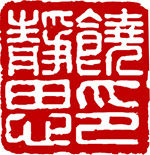
Jikishinkage-ryū (直心影流) was the name chosen by Yamada Heizaemon Ippūsai Mitsunori (山田平左衛門光徳) to refer to his inheritance of the teachings of Takahashi Jikiōsai (直翁斎), whose Jikishin Seitō-ryū he practiced and possibly updated or merged with his practice in a branch of the Edo line of Yagyū Shinkage-ryū.
Jikiōsai had studied the kenjutsu of Kamiya Denshinsai, who was the successor of Ogasawara Genshinsai (小笠原源信斎長治; 1574–16441; said to have refined his art during years spent in Ming China). Ogasawara was a student of Okuyama Kyūgasai, an early disciple of Kamiizumi Ise-no-kami.
The school’s now-familiar Kashima-shinden origin story — Matsumoto Bizen-no-kami as founding ancestor, a dream-transmission from the Kashima deity Takemikazuchi — was a mid-eighteenth-century documentary addition by the eighth head, Ippūsai’s successor Naganuma Kunisato. The Naganuma line’s own account of its heads, in the 1800 Hōjō scroll copied by Ogawa Yashichi, is read against the scroll images in Denkei of Jikishinkage-ryū.
By the late early-modern period the school had divided into three branches: the Naganuma-ha (長沼派), the orthodox trunk that carried the bōgu-and-shinai reform; the Fujikawa-ha (藤川派); and the Odani-ha (男谷派), which embraced competitive matches and became closely tied to the Tokugawa Kōbusho. This chapter follows the Edo dōtō of the Odani line — from Fujikawa Yashirōemon Chikayoshi and Akaishi Gunjibei Fusuke through Danno Gennoshin to Odani Seiichirō — the line that absorbed the Fujikawa house and issued, in the twentieth century, in Yamada Jirōkichi’s Seitō-ha.
It was in this line that swordsmanship crossed the Restoration. Odani Seiichirō, foremost swordsman of the Tenpō era, headed the Kōbusho and trained Sakakibara Kenkichi, who — remembered as “the last swordsman” — kept the art before the public in early Meiji through his gekken-kōgyō exhibitions; Yamada Jirōkichi preserved and codified that transmission as the Seitō-ha; and, on the Naganuma side, Tokunō Sekishirō carried Jikishinkage-ryū into the Metropolitan Police and became the first recipient of the Butokukai’s hanshi title. The Edo heads of that Odani line are followed here in succession.
Naganuma-ha
The Naganuma line under Kunisato’s successors at Shiba kept the largest kata repertoire of the three branches. The Jikishinkage-ryū hisho ichi (直心影流秘書一), a Naganuma house text, describes seven sets: Hōjō, Jū no kata,2 Koryū (古流, done with shinai), Habiki (the Koryū forms done with a habiki blade), Kodachi, Enkyō (円橋) and Saya no uchi (鞘之内, a drawing curriculum of fifty-four forms in its own manual); a Shibata domain inspection of Bunsei 2 (1819) adds a Kasumi no kata (霞之形) known from nowhere else (Karukome Yoshitaka 2013) (pp. 227–228). In shinai practice the branch fought from jōdan. The Ōnogi ikken (大禾一件), the record of an An’ei 2 (1773) match between Naganuma Shōbee’s men and the founders of Kyōshin Meichi-ryū, shows every Naganuma swordsman in jōdan in every bout, against opponents who used hassō, seigan, two swords and the short sword (pp. 202–210, 225). Jōdan was held in special regard, as a posture from which one could press with shikake and still answer the opponent, and it was still recognized as the Naganuma mark in the 1850s. The branch’s Jikishinkage-ryū kyūri no maki chūkai hisho (直心影流究理之巻注解秘書, Tenpō 9 / 1838) urges that shinai practice and kata be trained together and that kata not be neglected for the sake of winning (pp. 238–242, 263–265). When the long shinai and the thrust spread through Edo in the Tenpō era, the Naganuma line kept its jōdan and its old forms, and its Shibata leader Shimamura Toya criticized the long shinai and declined matches fought for petty technique (pp. 265–266).
The Hisho ichi notes that Habiki has no forms of its own but borrows the five Koryū forms; in the contemporary practice of the Odani-ha and Fujikawa-ha, Habiki is an arrangement of four kata performed in three continuous parts (smoothly moving from summer to autumn). According to Sakai Kazuya there is also an Ōkoryū (大古流) section of the curriculum: Koryū, Ōkoryū and Marubashi are practices that are not listed in standard mokuroku, similar to the convention in other lines of Shinkage-ryū where Marobashi is not listed in densho.3 The same work begins its saya no uchi section with 鞘ノ内三, denoting either a small set of three kata or three sets of kata; the distinction is unclear. The fifty-four-form Naganuma manual of saya no uchi is 河崎藤之丞義追’s 『鞘之内秘伝書』 (鈴鹿家文書, AJKF), and its transmission flows through Naganuma Tadasato.
According to Karukome, the branch survives as the Tōkyō Naganuma Shōbee-ke (東京長沼正兵衛家), the present-day Tokyo branch of the family, which holds the school’s oldest originals: Mitsunori’s 『兵法雑記』, Takahashi’s 1686 『稽古法定序幷理歌』 and the 1773 『大禾一件』. Karukome bases his analysis on Nakamura Tamio (中村民雄), “幕末関東剣術流派伝播形態の研究(2),” 福島大学教育学部論集 社会科学部門 第66号, 1999.
Kunisato (国郷, 1688–1767), the eighth generation — full style 長沼四郎左衛門尉藤原国郷, tsūshō Shirōzaemon (四郎左衛門) — was the third son of Yamada Mitsunori. He received the school from his father in 1708, went to Edo, refined the bōgu and shinai, and died in Meiwa 4 (1767) on the 24th day of the seventh month (one account says the 10th), aged eighty, from Shimotsuke. After him Naganuma practice consists of two houses: the Shirōzaemon-ke (四郎左衛門家), the blood line or head house (宗家長沼派), and the Shōbee-ke (正兵衛家), the adopted line or branch house (別家長沼派).
Naganuma Shirōzaemon-ke 四郎左衛門家
The line transmitted through Kanō-han in Mino.
The Shirōzaemon-ke is often called the Sōke Naganuma-ha (“head-house” Naganuma branch). It is the main line that went to Mino Kanō and culminated in the well-known early twentieth-century shiai competitor Wasato.
Tokusato or Norisato (徳郷; 1741–1777, d. age 36) is Kunisato’s biological son, born in his father’s late years; he learned the school from Tsunasato and, through the Nagai lords’ transfer to Mino, became the root of the Kanō-han Naganuma line. Genealogically the biological son, Tokusato, heads the main sōke (宗家 / 四郎左衛門家), while the adopted Tsunasato’s descendants form the bekke (別家 / 正兵衛家). The formal dōtō, however, ran the other way — Kunisato (8th) to the adopted Tsunasato (9th) to Fujikawa (10th) — so the school’s headship passed through Tsunasato and bypassed Tokusato’s line entirely.
The Kanō-han line began when Nagai Naotsune (尚庸, 1631–1677), third son of Nagai Naomasa, was granted 20,000 koku in Kawachi in 1658; the Nagai (永井) house then moved through Shimotsuke Karasuyama, Harima Akō and Shinano Iiyama into Musashi Iwatsuki, and under the fourth lord Naonobu (直陳) settled at Mino Kanō at 32,000 koku, remaining there with no further transfer to the end of the Edo period. Yamada Mitsunori had been an Edo-duty retainer of the Nagai at Musashi Iwatsuki, so the sword house was a Nagai retainer family from the start. When the Nagai went to Kanō, Tokusato went with them as the domain’s hereditary Jikishinkage-ryū instructors, while Tsunasato’s branch instead took service at Numata.
Tokusato’s tsūshō is Shirōzaemon (四郎左衛門), the hereditary by-name of this head house (Karukome styles him 四郎左衛門徳郷). As with any such house name it was re-used across generations, with individual teachers distinguished by their imina where known. (The Shōbee tsūshō — 正兵衛, with the Issei-kai variant 庄兵衛 — belongs instead to Tsunasato’s branch house.)
- Kunisato (1688–1767)
- Tokusato (徳郷, 1741–1777)
- Sadasato (貞郷, d. 1781; great-grandson of Yamada Mitsunori)
- Sukesato (亮郷)
- Masasato (万郷, d. 1852)
- Yasusato (楽郷, eldest son, died young)
- Wasato (和郷, hanshi 1925, second son)
- Akisato (昭郷)
Wasato was named hanshi by the Butokukai in 1925 and continued this branch to Akisato, who is the last recorded master.
Naganuma Shōbee-ke 正兵衛家
The line transmitted through Edo and the Numata-han.
The Shōbee-ke (the Shōbee house), also called the Bekke Naganuma-ha (別家長沼派; “branch-house” Naganuma branch), is the cadet line affiliated with Numata, and the line from which the 1800 Hōjō densho examined on the lineage page comes. It is in this line that the tsūshō Shōbee (正兵衛) is used.
Tsunasato (綱郷, d. 1772), the ninth generation — full style 長沼庄兵衛尉活然斎藤原綱郷, tsūshō Shōbee-no-jō (庄兵衛尉), gō Katsuzensai (活然斎) — was Kunisato’s adopted son (originally Saitō Yūgorō). The death date is Nagao’s, who identifies the Naganuma Shōbee of the Gekiken sōdan Jikishinkage-ryū entry — the one 「今芝金杉に住して上手なる由」 — as Tsunasato (Nagao Susumu 1999); it sits correctly between Kunisato’s death in 1767, after which Tsunasato went independent, and 1773, by which year Tadasato held the name 正兵衛. The adopted man carried the school first, as a stand-in while Kunisato was old and childless; once the blood son, Tokusato, was born and grew up, he took the head house and the adopted man’s descendants became the branch, even though the adopted line had seniority in training.
The Naganuma were Numata-han instructors from Tsunasato onward, and the domain taught Jikishinkage-ryū for several generations. Karukome’s analysis of the 正兵衛家 line runs:
- Tsunasato (綱郷) — originally Saitō Yūgorō; Kunisato’s daihiko; served Toki Yoritoshi (of Numata) from 1723; stayed resident in Edo when the Toki moved to Numata in 1742; after Kunisato died in 1767 he went independent and opened the Shiba Atago-shita dōjō, with some three thousand students.
- Tadasato (忠郷, d. 1807) — succeeded Tsunasato; already the 正兵衛 by 1773 (Karukome names him as the Shōbee in the 1773 Ōga/Momoi match); issued licenses through the Kansei era.
- Naosato (直郷, d. 1839, adopted) — shihan until 1819, then retired to Numata.
- Takasato (孝郷) — d. 1827, no heir.
- Terusato (輝郷) — d. 1831, aged twenty-six.
- Masasato (恂郷, d. 1865) — the Numata-han instructor whose dōjō Tokunō Sekishirō entered.4
- Michisato (称郷, d. 1895, gō 可笑 Kashōjin) — closed the dōjō at the abolition of the domains and the 1876 haitōrei.
The line’s dōjō was at Edo Mizaka (江戸見坂), inside the Numata domain’s Edo residence. Tadasato held the name 正兵衛 across the entire Kansei era (a license to Kawasaki in 1789, students through about 1801), so the Kansei 12 (1800) Hōjō transmitted at Edo Mizaka by 長沼正兵衛 is his.
The best-documented pupil of this branch in the Meiji period is Tokunō Sekishirō (得能関四郎, 1842–1908), who entered the Shiba-Atagoshita dōjō of Naganuma Masasato (長沼恂郷, also written 恂教, gō Shōbee) in 1856, took menkyo kaiden in 1862, and after his teacher’s death continued under the son — recorded in his own sources only as 可笑人 (Kashōjin), that is, Michisato. He went on to serve as juku head of the Naganuma dōjō, and later took the first seirenshō and the first hanshi title the Dai Nippon Butokukai awarded.
The Numata house lapsed in early Meiji. Its last head, Michisato — the fifteenth holder in this branch’s continuation of the school’s generational count — abandoned the transmission of kenjutsu at the abolition of the domains. The Naganuma line as Numata-han instructors thus ended its own headship, while the head house continued separately at Kanō, and other lines carried the practice onward.
Fujikawa Yashirōemon Chikayoshi
Fujikawa Yashirōemon Chikayoshi (藤川弥司郎右衛門近義; 1726-1798), the tenth-generation head of Jikishinkage-ryū, whose Edo town-dōjō at Shitaya Chōjamachi (下谷長者町) opened in Hōreki 6 (1756), was reputed to have three thousand students and to have produced Akaishi Gunjibei Fusuke alongside Sakai Ryōsuke (Nakabayashi Shinji, n.d.).
Nakabayashi’s encyclopedia treatment frames him as the senior disciple of Tsunasato who continued the orthodox Naganuma line. In the dōtō register his formal style is Fujikawa Yashirōemon-no-jō Fujiwara Chikayoshi (藤川弥司郎右衛門尉藤原近義) (Kashima-shinden Jikishinkage-ryū Isseikai, n.d.).
Karukome (2013) details the formation of the Fujikawa-ha, noting that Fujikawa Yashirōemon Chikayoshi entered Naganuma Kunisato’s school and then after Kunisato’s retirement trained under Naganuma Shōbei. When he died, his adopted son Chikanori took over the dōjō, but died shortly thereafter.
The adopted son-in-law Chikanori married Chikayoshi’s daughter, so two young heirs were left after Chikanori’s sudden death — Chikatsune and Seisai. They were not yet adult at the time, so Akaishi Gunjibei Fusuke served as guardian to the brothers.5
Fujikawa Seisai (藤川整斎, 1791–1862) is the author of Reiken ryakkai (1857, Tokyo National Museum) and Seisai zuihitsu (整斎随筆, National Archives). Karukome notes that the Seisai zuihitsu records, as a kikigaki, a description of a match by Seisai’s grandfather Fujikawa Yashirōemon Chikayoshi, through which the character of Fujikawa-ha matches can be glimpsed. Like the Naganuma line, the Fujikawa-ha fought from jōdan, as Chikayoshi’s match with Suzuki Yatōji and the bouts of Sakai Ryōsuke show (Karukome Yoshitaka 2013) (pp. 243–244). Saitō Akinobu credits Seisai with re-examining the school’s documents and working through the Hōjō and the other forms so that they could be used in matches; Saitō’s own Jikishinkage-ryū kenjutsu gokui kyōju zukai (1901) sets out four sets, Hōjō, the Jū no kata (written 鞱之形), Kodachi and Habiki, to which Yamada Jirōkichi’s Kashima shinden Jikishinkage-ryū adds Marubashi (p. 244). In the Reiken ryakkai of Ansei 4 (1857) Seisai criticizes matches fought only to win and the long shinai, and teaches that the purpose of training is to put aside distracting thought and settle the mind of munen musō (無念無想) below the navel; after him the branch pursued that training through kata (pp. 251–254, 263, 266).
Yamada Jirōkichi studied Fujikawa-ha in addition to his time learning from Sakakibara. With Sakakibara’s permission he continued his study of kata under Yamada Hachirō (山田八郎); for this reason there is a view that what Yamada transmitted differs from the Odani-ha as it stood before Sakakibara. Ishigaki maintains that Yamada Jirōkichi also trained under Saitō Akinobu after Sakakibara’s death.
Sakai Ryōsa / Ryōsuke (酒井良佐 / 酒井良佑) was a Fujikawa-ha swordsman whose match is described in Shimizu Rekishū’s Ariya nashiya, giving the actual line: “Ryōsa, with a great shout, [struck] from jōdan toward the crown of the head…” — i.e. the same upper-stance, striking-from-above style the school is known for. The essay is reprinted in Zoku Nihon zuihitsu taisei, vol. 8.6
Akaishi Gunjibei Fusuke
Akaishi Gunjibei (赤石郡司兵衛), honorific -no-jō (尉), honsei Fujiwara (藤原), imina Fusuke (孚祐), gō Hanryūken (斑龍軒), was the eleventh-generation head of Jikishinkage-ryū in the Kashima-shinden reckoning, standing between Fujikawa Chikayoshi (10th) and Danno Gennoshin (12th) in what became the Odani-ha. His placement is consistent across the school’s own dōtō register and the Kobudō Kyōkai succession lists (Kashima-shinden Jikishinkage-ryū Isseikai, n.d.; Nihon Kobudō Kyōkai, n.d.).
He studied under Fujikawa Yashirōemon Chikayoshi, the tenth-generation head (Nakabayashi Shinji, n.d.). His recorded students are Danno Gennoshin (団野源之進; the twelfth-generation head), Ishikawa Seheiji (石川瀬平二) (Nakabayashi Shinji, n.d.), and Toda Einosuke.
The Jikishinkage-ryū densho-shū (直心影流伝書集) lists Toda Einosuke (imina Ōban Yoshishige〔大判良茂; imina reading uncertain〕, styled Isshinsai) as one of Akaishi’s students:
At the age of twenty-four he came to Kyoto and opened a kōbujō, and his name became greatly renowned. Those who received instruction from him numbered several thousand in all, and those who attained the true transmission were likewise many. He died in Meiji 4 (1871), the kanoto-hitsuji year, in the twelfth month, aged sixty-six.
In Meiji, Ōishi Susumu (大石進), Okumura Sakonta (奥村左近太), Takayama Minesaburō (高山峰三郎), Koteda Yasusada (籠手田安定), and Abe Morie (阿部守衛) later visited the school he founded in Kyoto. Unlike the ninth-generation Naganuma line (Numata-han service), Akaishi sits in the Fujikawa Edo town-dōjō tradition; no domain appointment is attested.
Danno Gennoshin
Danno Gennoshin (団野源之進; gō Shinpansai 真帆斎)7 was the teacher of Odani Seiichirō; his birth and death are not easily fixed, though Odani inherited his dōjō after Danno’s death, c. 1857.
Danno was the twelfth-generation head of Jikishinkage-ryū8 in the Kashima-shinden reckoning that counts from Matsumoto Bizen-no-kami, and the teacher of Odani Nobutomo (男谷信友).9 His imina is given as Yoshitaka (義高), with the variant 義孝 in at least one lineage register.10
He studied under Akaishi Gunjibei Fusuke (赤石郡司兵衛孚祐), the eleventh-generation head, and maintained a dōjō at Honjo Kamezawa-chō (本所亀沢町) in Edo (Nakabayashi Shinji, n.d.). The Kobudō Kyōkai registries place him in the orthodox line between Akaishi and Odani — Akaishi Fusuke — Danno Shinpansai (Yoshitaka) — Odani Seiichirō Nobutomo (Nihon Kobudō Kyōkai, n.d.).
His principal recorded student is Odani Nobutomo (tsūshō Seiichirō, gō Seisai), later “the sword-sage of the Bakumatsu.” Odani received the tekiden (的伝; the orthodox inner transmission) from Danno in Bunsei 6 (1823) (Nakabayashi Shinji, n.d.). On Danno’s death Odani was given the Kamezawa-chō dōjō, relocating there in Ansei 5 (1858) — the only indirect anchor available for the period of Danno’s death.11
End Notes
-
Japanese Wikipedia (opens in a new tab) gives Ogasawara Genshinsai Minamoto no Nagaharu (小笠原源信斎源長治, 1574–1644), and Karukome gives the same dates, taken from Iwasa Masaru’s Kashima shinden Jikishinkage-ryū (2005), p. 26 (Karukome Yoshitaka 2013) (p. 73). The later documents of the line at the Odawara City Library — a Shin-no-shinkage heihō mokuroku of Kanbun 10 (1670), and a menjō dated Kanbun 13 (1673) in Karukome’s tables but Kanbun 11 (1671) in his source list (pp. 38, 64–69, 77, 281) — are therefore not Nagaharu’s. Karukome attributes them to 小笠原源信斎, but the citation of the 1670 mokuroku on the empiken blog reads 「小笠原玄信義晴より小林市郎右衛門」, and its lineage chart sets Ogasawara Yoshiharu (義晴) after Nagaharu as a separate issuer: a successor using the gō Genshin (玄信). Karukome names the recipient Kobayashi Shichisaburō (小林七三郎). ↩
-
Jū no kata and tō no kata overlap, and their naming differs by line of practice and by source. ↩
-
We are grateful to László Zentner of the Naganuma-ha for providing this information. ↩
-
Readings and death years for the Naganuma and Fujikawa men of the Numata-han follow the Sōtairoku grave register’s Numata page (https://soutairoku.com/01_soutai/11-5_kakuhan_jinbutu/2-25_numata.html (opens in a new tab)), which gives 綱郷 つなさと d. 1772, 忠郷 ただ さと d. 1807, 直郷 なおさと d. 1839, 万郷 まささと d. 1852, 恂郷 まささと d. 1865 (其術入神) and 称郷 みちさと d. 1895, alongside 藤川近義 ちかよし d. 1798, named there as 藤川派の祖, and 藤川貞近 さだちか d. 1862, both recorded as Numata-han samurai. Two cautions: it gives 恂郷 and 万郷 the same reading まささと, which may be a transcription artifact rather than a genuine homophone across the two houses, and it places 直郷 in 栃木県沼田市 when Numata is in Gunma — so treat it as corroborating readings, not as a primary authority. ↩
-
According to Ishigaki, Chikanori was brought in from the Kōno (河野) family of the same domain and married to Chikayoshi’s daughter. ↩
-
His given name is written 良佐 by Karukome but 良佑 (glossed Ryōsuke) by Kotobank. ↩
-
Every Japanese source gives the tsūshō reading as Gennoshin (源之進 = げんのしん); the gō is read Shinpansai (真帆斎 = しんぱんさい), an irregular reading of 真帆 confirmed by Kotobank furigana. The kyūjitai form 眞帆斎 also appears in the Kobudō Kyōkai registries. The form “Genshin” is not attested in any source consulted. ↩
-
Japanese Wikipedia, 直心影流剣術, naming Fujikawa-ha (from Fujikawa Chikayoshi), Danno-ha (from Danno Yoshitaka / Shinpansai), and the Odani-ha “among many branches.” ↩
-
男谷 is read Odani in the Kotobank headword and in this lineage’s house usage; some references (e.g. Japanese Wikipedia) read it Otani. Retained as Odani here. ↩
-
義高 in Japanese Wikipedia and the Kobudō Kyōkai pages; 義孝 (same reading) on the Issenkai Seitō page. Both are internal house attestations, not externally corroborated. The formal honsei also splits: 藤原 (Fujiwara) in the naginata registry, 源 (Minamoto) in the kenjutsu registry. ↩
-
Odani’s date of entry into Danno’s school is reported inconsistently: Bunka 2 (1805), age 8, in Japanese Wikipedia and a popular online account; Bunka 14 (1817), with full transmission gained in four years, in Kotobank (Nakabayashi Shinji, Nipponica). These are incompatible sequences and are compounded by the separate dispute over Odani’s own birth year (1798 vs 1810). Treated as unresolved. ↩