The six kodachi kata of the Seitō-ha come down from the Fujikawa-ha, which fixed them as six named, weapon-specific kata, published by Saitō Akinobu in 1901. Karukome finds that the kodachi, like the habiki and marubashi, developed independently in the Naganuma and Fujikawa branches, which differ in the number of forms and in their movements (Karukome Yoshitaka 2013). This page looks at Saitō’s record of the set and at the kata themselves.
Kodachi Kata
Eighteenth- and early-nineteenth-century mokuroku of the Naganuma line do not explicitly mention the six kodachi kata practiced in the Seitō-ha and related lines today.
Formally, the set is six kata in which uchidachi holds a tachi with tsuba and shidachi a kodachi with tsuba. In the seasonal ordering of the curriculum it is performed with summer kiai (The Truth of the Calm Spirit, “Technical Overview”), so a strong ei runs through it. It is the first upper-level set, and it relies on body mechanics that would be very difficult without unpō, Hōjō and Tō no kata behind them: it presupposes someone already being a Jikishinkage-ryū practitioner, rather than teaching someone how to become one. Though only six kata, they take time to develop, and they are more heavily modified from their original intention than the earlier sets — possibly to conceal what is going on from outsiders.
In the Odani-ha those were imported from the Fujikawa-ha (藤川派) into what is now sometimes called the Seitō-ha by Yamada Jirōkichi. The Seitō-ha maintains five kata sets — Hōjō (法定), Tō no kata (韜之形; tactical/encirclement forms), Kodachi (小太刀), Habiki (刃引) and Marubashi (丸橋; alt., Maruhashi) — but its parent the Odani-ha, by the end of the nineteenth century, practiced only Hōjō as kata, exploring upper-level tactics instead during shinai-uchikomi-geiko. The Naganuma family line, by contrast, has a larger curriculum today, including saya no uchi (battō and iai). The Naganuma house texts describe a kodachi set of their own, seven forms in one text and six in another; the set practised today is the Fujikawa-ha’s.
Kenjutsu Gokui Kyōju Zukai
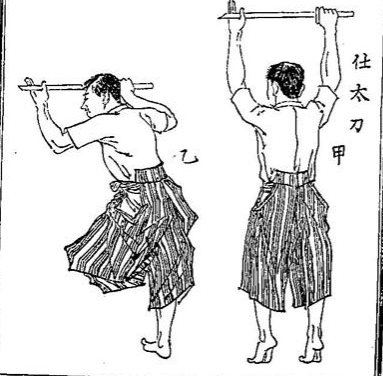
Saitō Akinobu’s Jikishinkage-ryū kenjutsu gokui kyōju zukai (直心影流剣術極意教授図解; 国立国会図書館デジタルコレクション, 1901) (Saitō Akinobu (斎藤明信) 1901) documents what is now the Seitō-ha curriculum, with ink drawings of the kata (as does Yamada’s 1915 treatise, with photography extensive for its time). Its table of contents (p. 12) lists the kodachi set under the heading 小鞱之形部 as six kata, each with Saitō’s ruby: 風勢 fūsei, 水勢 suisei, 切先返シ kissaki-gaeshi, 鍔取 tsuba-tori, 突非押非 toppi-oppi and 圓快 enkai (ruby エン〔クワイ?〕). The note that follows on the same page belongs to the next heading, the Habiki, which Saitō’s printer sets as 双挽之形部 (for 刄挽):
此形は四本なれども法定の裏の手の形なるが故に名所は法定に同じ二本目三本目とつゞけて打つ故に他見する時は三本の形の様に見へるものなり
These forms are four, but because they are the ura no te (裏の手; reverse-hand) forms of the Hōjō, their names are the same as the Hōjō’s. Because the second and third are struck continuously, to an onlooker they look like three forms.
Saitō’s ura no te no kata is therefore his name for the Habiki, the four forms that carry the Hōjō names. In practice, the names are not always used explicitly: when I visited Japan in 2026, practitioners called the Habiki forms simply ipponme, nihonme and sanbonme (一本目・二本目・三本目; first, second, third), which fits Saitō’s remark that the four look like three. The six kodachi kata are absent from the Naganuma mokuroku I have; what is demonstrably a Fujikawa-ha development, fixed in Saitō’s printed edition, is their codification into six named kata with set weapon specifications. (His 1901 introduction mentions the daishō 大小 bokutō pairing only in passing; by 1900 the kodachi-side equipment already felt routine in the line.)
Saitō’s section heading is itself telling. He writes the set not as 小太刀 but as 小鞱之形, with 鞱 (the 革-radical variant of 韜, tō; tactic, the graph the 1800 mokuroku attaches to each entry of the Tō no kata (1800 mokuroku)), and he glosses it コシナヒ, ko-shinai: the forms of the small shinai.
The Sets Together
In practice the relationship runs in both directions. Kodachi is in some ways closer to Hōjō than Tō no kata is, in that much of its true intention is obscured. Hōjō is in turn explained quite a bit by Habiki, an older arrangement of Hōjō (the koryū no kata of the Naganuma line) and, in Saitō’s words, its ura no te; kodachi practice is a necessary intermediate step toward it. If Hōjō is related to Sangaku-en no tachi in other lines of Shinkage-ryū, then Habiki is similar to, or related to, Enpi no tachi, from which Sangaku-en is said to have been derived (Ogasawara and the nittō). Hōjō provides the foundations; Tō no kata develops basic tactics and the concept of the centre-line; kodachi teaches infighting and stability around the central axis, along with an explosive short-range power; and Habiki unifies the above, refining the lower-body connection and the use of the back bow for stability, agility and strength.
The final set, Marubashi, is also performed with a kodachi, but the lines differ over who holds it: in the Naganuma line shidachi takes the short sword and strikes the tachi down, while in the Fujikawa-ha uchitachi holds the kodachi and nothing is struck down; the densho gloss the kodachi’s light touch against the tachi as “a staff touching a bridge” (Yamada Ippūsai). In the Seitō-ha it is heavily ritualized and generally taken to concern psychological or spiritual matters, though it keeps tactical kuzushi as well — and Enkai, the last kodachi kata, recurs within it.
The Yagyū line shows how such kodachi-side practice functions. In Yagyū Shinkage-ryū kodachi is taught explicitly, as a documented step toward mutō-dori: Sekishūsai (柳生石舟斎 / 柳生宗厳, 1529–1606) received the mutō no ryū concept from Kamiizumi, and Munenori (1571–1646) systematized it in the Heihō Kadensho (1632), where the move from equal-length tachi to short-sword (kodachi) to no-sword (mutō) is the school’s distinctive architecture and the kodachi material its key middle term. Ippūsai’s Edo Yagyū training would have descended from Munenori’s codification — so Sekishūsai is the ultimate source, the Edo Yagyū line the immediate one.
Analysis
The 1800 Hōjō text touches on the short sword once, in its commentary on Chōtan Ichimi: 「弐人ニ、長短ニよらず、初メノ八相ノ心アレバ、長短ノ差別ニ不及。」 — “between two people, not depending on long or short: if one has the initial hassō mind, the distinction of long and short does not arise” (1800 mokuroku). In Shinkage-ryū there is a maxim to the same effect: one mind, any weapon. Kodachi is that teaching made into a curriculum.
If anyone imported the Yagyū sequence of tachi, kodachi and mutō, Ippūsai is by far the most plausible vector. His Edo Yagyū training is established, and his renaming of the school to Jikishinkage-ryū is the moment its identity was consciously reformulated — the point most receptive to integrating outside material. The shared cross-school kata vocabulary (Ittō Ryōdan, Uten Saten, Chōtan Ichimi, common with the Yagyū Sangaku-en) shows his generation working from the same Kamiizumi-era glossary as the Yagyū line, and his return to Takahashi in 1674, after his Yagyū years, followed by twelve years of training to his 1686 inka, would have given him the life-phase to consolidate material from several sources into one curriculum. This is a possibility, not a documented transmission.
The Six Kata
The six kodachi kata can be thought of as three pairs. The first two use an aggressive kasumi (霞; mist (posture)) entry, drawn from Ittō Ryōdan — Fūsei (風勢; wind strength) entering from above, Suisei (水勢; water strength) upward from below. The second two, Kissaki-gaeshi (切先返; tip reversal) and Tsuba-tori (鍔取; taking the guard), use an upward and inward motion, drawn from the randori (乱取り; free practice) section of Uten Saten. The fifth, Toppi Oppi (突非押非), also has movements from Uten Saten (an upward-left sweeping motion on its initial movement), while the sixth, Enkai (圓快; round and at ease), has a dramatic nagashi similar to those in both Ittō Ryōdan and Uten Saten. Enkai is the key to the other five, and it is one of the circles (圓) that recur through the curriculum, appearing again in Marubashi (Yamada Ippūsai). The set opens by naming two of the godai (五大; five great elements), wind and water, and in my own practice I map all six onto the great elements, with the sixth element held back for Enkai.
Trained with increasingly strong cuts from uchidachi, kodachi develops an extremely powerful, explosive and stable form of strength and sharpens the sense of distance and timing; it gives a feedback loop akin to jigeiko, push-hands or randori. The initial contact can become so sudden that uchidachi, wielding a tachi in two hands, is sent reeling back, uprooted. Hips are held square: other Shinkage-ryū will often pull across the koshi (腰; lower back or hips) to generate power.
The set relies on a mindset laid down much earlier. Tai-atari (体当たり; body strike) appears in Hassō Happa as what at first seems a ritual movement, but it establishes what kodachi demands: full commitment, without concern for success or failure — one throws one’s life away to get close enough to the tachi to survive. The mokuroku’s tai-ate no koto (体当之事) puts it plainly: “once one’s own body is made robust and firm, strike in … the mind of striking with the body” (1800 mokuroku). Toppi Oppi carries the same mindset into recovery from great adversity, much as Araki-ryū torite kogusoku places shidachi in untenable positions from which they must recover (Araki-ryū).
As with Hōjō, the omote performance conceals as much as it shows. The yielding nagashi, finishing on crossed ankles on the outer edges of the feet, trains the tendons of ankle and shin but is not combative, and the final cut performed that way is a slow ritual descent with mu kiai. Taking the kata apart through kuzushi reveals much more, and makes the set a bridge to kogusoku (小具足; armed grappling), which some lines influenced by Shinkage-ryū keep but which is absent from the formal Jikishinkage-ryū kata curriculum; related arts that keep a jūjutsu curriculum, such as Kashima-shinryū, do similar movements with the tachi. Some entries that bypass the cut entirely must be explained orally, and may be an example of the upper-level teaching of hassun no nobegane (八寸の延金) (Ogasawara).
The influence runs back into the earlier sets too: movements from Kissaki-gaeshi let one move around the opponent’s blade in Matsukaze of the Tō no kata — an instance of marubashi, unimpeded movement — and the same patterns are encoded in Ryūbi and Menkage, waiting to be found through kuzushi and variations of angle and timing.