Register record
Identity & authority
- Reliability
- The fullest account is his entry in the Shidankai's 1911 register of men who served the nation (Kokuji ōshō hōkō shishi jinmeiroku), compiled while he was alive. Two popular books add detail: a 1887 collection of lives of "chivalrous men" and a 1913 book on Sakamoto Ryōma that prints his own account. They agree on the main points and differ on some: the 1887 book has him merely suspected of the Tsukuba rising and adopted in 1864; the 1911 register has him join it and be adopted in 1865. His Taiwan mining is in the Government-General's files (1911). The 1887 book also prints, in full, a petition he signed in 1883 that tells his Meiji mining career in his own words. His teaching of Kawashima rests on Namiki Yasushi's account. A 2023 reference inquiry at Narita City Library lists further works, most not yet read for this record.
- Attestation
- corroboration: —
Names
| type | kanji | romaji | reading |
|---|---|---|---|
| myoji | 信太 | Shida | |
| tsusho | 歌之助 | Utanosuke | |
| myoji | 青柳 | Aoyagi | |
| yomyo | 熊吉 | Kumakichi |
Dates
- Born
- (1837)
- Died
- Floruit
- Kōbusho instructor from 1862; under Katsu Kaishū in 1867–68; mining in Taiwan in 1911; in his last years teaching Kawashima Takashi there.
Origin & status
- Locality
- born at Hongō, Edo; later of Arano village, Kaijō district, Shimōsa, by adoption
- Offices
- at the Kōbusho from Man'en 1 (1860); kenjutsu shihan (劍術師範) from Bunkyū 2 (1862)
- infantry instructor (歩兵指圖役), retained at 300 koku under Katsu Kaishū as military commissioner, Keiō 3 (1867)
- After the Restoration, judge of the arrest office (捕亡司判事) and head of the prison office (囚獄司長), 1869; an official (御用掛) of Nara prefecture under Kaieda Nobuyoshi, 1869; resigned in 1870 and worked for the Hokkaido Development Commission (開拓使)
- 総房三州鎮静方, charged with keeping order in the three provinces of Kazusa, Shimōsa and Awa, 1868 (Keiō 4); the shogunate's chronicle calls him 步兵差圖役格 軍事掛手附 (of infantry-instructor rank, attached to the military affairs office) and 總房鎭靜方取締
- continuer (繼續人) of the Kaikokusha (開國社), a whaling company, 1883
Lineage & parentage
- Father
- Aoyagi Hikoemon (青柳彦右衛門), a shogunal retainer; Kumakichi was his fifth son.
- Teacher
- Odani Shimōsa-no-kami Fujiwara Nobutomo (Odani Seiichirō, 男谷精一郎)
- Attestation
- —
- Teacher
- Takenaka Tetsunosuke (竹中鐵之助), of Kanda Myōjin-shita
- Attestation
- —
Relations
Students
Shida Utanosuke (信太歌之助) was born Aoyagi Kumakichi (青柳熊吉) in Edo in 1837. A pupil of Odani Seiichirō in Jikishinkage-ryū and a Kitō-ryū jūjutsu man, he was taken on as a Kōbusho instructor in 1862, went to Kyoto in the shogun’s vanguard, fled arrest in 1864 and re-entered service under Katsu Kaishū at the end of the shogunate. In 1869, as an official of Nara, he argued down a proposal to melt the Great Buddha of Tōdai-ji for its metal. He spent the Meiji era in mining, and in his last years in Taiwan was the first Jikishinkage-ryū teacher of Kawashima Takashi. He is remembered in his adoptive home of Chōshi as a swordsman and a master of the spear.1
 (opens in a new tab)
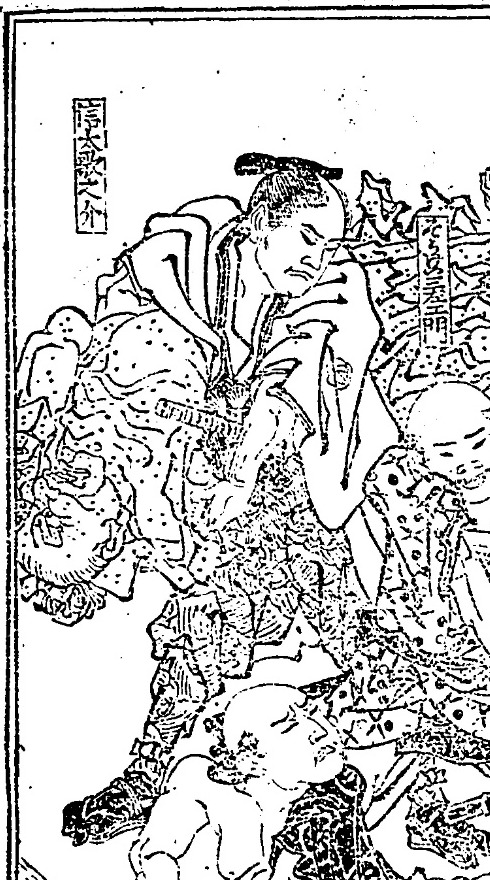
信太歌之介, from a plate of the book's subjects in Honchō kyōkaku den (1887), drawn in his lifetime but as a stock figure, not from life. National Diet Library, public domain.
Early Life and Training
He was born in Tenpō 8 (1837) at Hongō in Edo, the fifth son of the shogunal retainer Aoyagi Hikoemon (青柳彦右衛門); Kumakichi was his childhood name. As a young man he entered the school of a hatamoto named Tsutsui (筒井) and reached the inner levels of archery, horsemanship, the sword, jūjutsu and the spear, and in Ansei 1 (1854), on his teacher’s instruction, he travelled through the Kantō provinces.2
His own account, given in old age, names his teachers. He studied swordsmanship under Odani Shimōsa-no-kami Fujiwara Nobutomo, that is Odani Seiichirō, at Honjo Kamezawa-chō, and jūjutsu under Takenaka Tetsunosuke (竹中鐵之助) of Kitō-ryū, who lived below the Kanda Myōjin shrine. In those days, he said, Aoyagi Kumakichi was spoken of as the best jūdōka in Japan (其頃青柳熊吉と言へば日本一の柔道家と言はれて居た).3
The Kōbusho and Kyoto
According to the 1911 register, he came to the Edo Kōbusho in Man’en 1 (1860) and was made a kenjutsu shihan (劍術師範) in Bunkyū 2 (1862); he then went up to Kyoto in the train of Tokugawa Yoshinobu, and again in Bunkyū 3 (1863) with the shogun Iemochi.4 The 1887 biography dates his first summons to the twenty-fourth day of the first month of 1862, when he was chosen as a Kōbusho kenjutsu instructor and made a direct retainer, and has him lodge near Nijō castle with the shogun’s vanguard.2
His name is also among the signatures to a petition copied into the manuscript chronicle Nanryō nenroku (南梁年録). It appears to be introduced as a statement by the Kōbusho’s kenjutsu men, written when an imperial envoy was travelling east to press for the expulsion of foreigners, which would place it in 1862; it pledges the signers’ service “even into fire and water” and closes with fifty-five names, among them Chūjō Kinnosuke (opens in a new tab), Sakakibara Kenkichi, Mitsuhashi Torazō (opens in a new tab) and Aoyagi Kumakichi.5 And the shogunal official Kawaji Toshiakira, in a letter of these years, singles out “Aoyagi Kumakichi’s handling” of an affair as splendid: it was, he writes, a matter for the sword, and he wishes the military spirit kept so that men fear it.6
Both books tell how, while he was practising at the fencing hall of the Kyoto town magistrate, a large man arrived and demanded a bout. A fellow instructor faced him with the shinai and lost when it came to grappling; Kumakichi then stepped down, and when the bout turned to grappling, threw him with a hip throw. The challenger was Sakamoto Ryōma, who asked his name and afterwards sought his friendship.2 3 “Sakamoto was a big man,” Shida remembered: “I am five shaku two sun, he was five shaku nine, and thick in the body; standing up, my mouth came to about his chest” (私は五尺二寸、彼の男は五尺九寸で、胴も太い、立上ると、私の口が龍馬の乳房の邊に當るのです), roughly 158 against 179 centimetres.3 In his own telling, Ryōma came with a letter of introduction from Katsu Kaishū; Kumakichi was twenty-six and Ryōma twenty-eight; and Ryōma went on to practise with him in Kyoto for some eight months.3
The 1887 biography also has him among the two hundred pupils whom Odani, as head of the shogunate’s fencing, led as a guard when the shogun visited the Sennyūji temple, and has him rewarded for driving off a band of rōnin there.2
Flight and the Shida Name
Back in Edo, he worked with Yamaoka Tetsutarō (opens in a new tab), Takahashi Ise-no-kami (Takahashi Deishū (opens in a new tab)), Sakakibara Kenkichi, Chūjō Kinnosuke and others for an accord between court and shogunate. When Takeda Kōunsai and Fujita Koshirō raised troops at Tsukuba in 1864, he was suspected of acting for them because he had known Kōunsai in Kyoto, and escaped arrest only narrowly. He fled into Kai, reaching his pupil 金子熊一郎 at Kōfu, hid in the mountains of Minobu, and went on to Osaka, where friends among the shogun’s guard took him in. Some hundred days later a sword friend in Edo, Nakano Kinzaburō (中野金三郎), sent word that the charge could be cleared, and he returned.2
The 1911 register puts it more plainly: his sympathies were with sonnō jōi (尊攘; revere the emperor, expel the barbarian), and in Genji 1 (1864) he left the shogunate’s service and joined the Tsukuba party; when it failed he hid in Shimōsa.4
He was then adopted by 信太鍛之丞, a fellow pupil of Odani and a hereditary gōshi of Arano village in the Kaijō district of Shimōsa, and in the autumn of Genji 1 (1864) took the name Shida Utanosuke.2 The register dates the adoption to the eleventh month of Keiō 1 (1865).4 In his own words, he had been on the point of execution over the Takeda Kōunsai affair, “and escaped by entering the Shida family.”3
Under Katsu Kaishū
In the second month of Keiō 3 (1867) he was called to the shogunate again. Katsu Kaishū, as military commissioner, issued his appointment: he was newly retained at three hundred koku, ranked above the two guard corps, and made an infantry instructor, and was about to be sent to Osaka when Yoshinobu returned the government to the court.2
In 1868 the Tokugawa house gave him charge of keeping order in the three provinces of Kazusa, Shimōsa and Awa. The 1887 biography has him taking over a force of three thousand eight hundred men with four cannon and fifteen hundred rifles, making his headquarters in the Musha district of Kazusa, and persuading companies of deserting shogunal troops in the region to lay down their arms, reporting each to Katsu.2 A 2023 essay that follows him through Katsu’s diary, where his name appears often that year, gives his post as 総房三州鎮静方, and records that the new government arrested him in the seventh month and held him in the prison at 伝馬町 until the second month of the following year.7
The 1911 register gives the outcome. Three thousand Tokugawa deserters had taken over Kazusa and were scattered by government troops in the fourth month. Seven hundred of them, under 戶田嘉十郞 and 增田直八, held out in the precincts of Kashima shrine in Hitachi; acting on instructions from Yasuba Yasukazu, staff officer of the government army, Shida talked them into surrendering. He did the same with seventy at Iwai station in Shimōsa, and took or cut down some dozens of the bandits loose in the two Sō provinces. In the sixth month he returned to Edo at Katsu’s word. In the seventh, on charges laid by the domain lords of Bōsō, he was named a rebel; seeing the notices posted in the city, he gave himself up at the Grand Headquarters. Twice he came close to execution, and was saved by the protection of Katsu, Yamaoka Tetsutarō and Kaieda Nobuyoshi.4
The shogunate’s own chronicle confirms the commission. Under the third day of the third month of Meiji 1 (1868) it prints a notice to the villages: 「步兵差圖役格。軍事掛手附信太歌之助儀。總房鎭靜方取締として。廻村いたし候間。爲心得。右村々江可被達候。」 Shida Utanosuke, of infantry-instructor rank and attached to the military affairs office, is touring the villages as supervisor of the Bōsō pacification, and the villages are to be told so.8
The 1887 biography tells the arrest at length. Hearing a rumour that he was gathering malcontents, the government’s headquarters sent troops against his residence at Nuke-benten in Honjo. Warned, he slipped away, meaning to go to Katsu, and at the Akasaka gate found himself already posted: 「德川龜之介家來 信太歌之介 同 多賀上總介 右之者共容易ならざる企を致すに付見當り次第搦捕可差出若手に餘り候ば鐵砲にて打殺し可申者也」. He and Taga Kazusa-no-suke, retainers of Tokugawa Kamenosuke, were plotting something grave; they were to be seized on sight and, if they resisted, shot. He went back to the Honjo house, and when several hundred government troops surrounded it, he and his friend Furukawa Fusajirō opened the gate and broke straight through them with some thirty men, hired ten boats at Eitai bridge and had themselves rowed out to Enomoto Takeaki’s warship Kaiyō Maru off Shinagawa. He left his men in Enomoto’s care, came back, and gave himself up at the headquarters in the Nishinomaru.2
He was held at the Kodenmachō prison with Amano Hachirō of the Shōgitai and dozens of his men, Naitō Hyōbu and others of Aizu, his own pupil Narikawa Teijirō (later the senior official Narikawa Naoyoshi), and Ishizaka Shūzō. He was questioned again and again and sentenced to die with Naitō; the two exchanged poems, and his was 「紅葉のいろこきかたハ風なくも先にちりゆくならひなりけり」 (the leaves of deepest colour fall first, even with no wind). Late in the eighth month of Keiō 4 (1868) the officers came for Naitō alone, and Shida was left. The book credits Yamaoka Tetsutarō and Katsu, who appealed for him to Saigō Kichinosuke, staff officer of the government army, and to Kaieda Takeji. He was released in the third month of Meiji 2 (1869).2
The Great Buddha of Tōdai-ji
Pardoned in the third month of 1869, he was made a judge of the new government’s arrest office (捕亡司判事) in the fourth month and head of its prison office (囚獄司長) in the sixth, and at the request of Sasaki Takayuki reformed the prisons and saved many prisoners from dying in them.4 Then Kaieda Takeji (Nobuyoshi), now governor of Nara, to whom he had gone to give thanks for his life, told him that Nara needed a man like him, and he went there as an official.2
It was the high tide of the Hirata and Nonoguchi schools of National Learning, when the Department of Divinities was at its most powerful, and someone proposed that the Great Buddha of Tōdai-ji, as a useless thing, be melted down (奈良の大佛を無用長物として之を鋳潰さん). The proposal went to a full council of the prefecture, which argued without reaching a decision, until Shida stood up. The Buddha, he said, was raised by the Emperor Shōmu and revered by every reign since; when Taira no Shigehira burned its hall, Minamoto no Yoritomo rebuilt it, and when it suffered again in Matsunaga Hisahide’s wars, it was restored under the third Tokugawa shogun. To destroy it now, in the very days of the restoration of imperial rule, could hardly be the court’s wish. Nara lived by the Buddha and the Kasuga shrine, and foreign visitors came to see them. Rather than speak of scrapping it, 「寧ろ一層修繕を加へ永く保存せん」: let it be repaired still further and kept for ever. The council came round to him, and the proposal was dropped.2
Had it been carried, the biography says, Nara would have lost its one great sight and become a lonely village; his motion was “a gift for a thousand years” (千歳の賜). When he resigned and went back east, in the twelfth month of Meiji 2 (1869), the abbot of Ryūshōin, the cloister that has the keeping of Tōdai-ji, gave him in thanks a blade by Sanjō Kokaji Yoshiie, one of the temple’s treasures.2 The 1911 register dates his resignation to the first month of 1870.4
Mining and Whaling
He went next to the Hokkaido Development Commission (開拓使), where he learned mining and sericulture, and afterwards left office altogether for private business.4 He spent the rest of the Meiji era in mining.3 The 1887 biography says that until 1877 he gave himself to oil, coal, mining and whaling, from Hizen in the west to the untrodden parts of Hokkaido; that he settled a “bamboo-spear and straw-banner” dispute between the Yamagata prefectural office and the people of Murayama district so that none of them was punished; and that in 1881, finding the land at Asahi-no-oka in Kitamura, Monō district, Rikuzen fit for a city, he petitioned the Senate to found a northern capital there, and presented the Imperial Household Ministry with gemstones from his travels. Again and again, it says, he handed a venture to its financiers just short of success and took nothing from it.2 His petition for a capital may be the one in the Meiji kenpakusho shūsei listed below.
The book closes his life with a petition he signed in the eleventh month of Meiji 16 (1883), which tells the same years in his own words.2 In the second month of 1870, he writes, he put a proposal for whaling to Kuroda Kiyotaka of the Development Commission. It was adopted and he went to the Commission at Sapporo, where Iwamura, its senior judge, told him that a whaling ship was being sought from America and set him meanwhile to the Kayanuma coal mine in Iwanai district. Three years passed and the ship never came. With Ishizaka Shūzō he founded an oil company, which foundered in a dispute with an American; Ishizaka left for Europe and America, and Shida went home to Chōshi, left his mother, wife and children there and, with a packet of money from Katsu Kaishū for the road, went alone into the north-east in 1875.
At Nagamatsu-yama in the Mogami district of Uzen he found good ore. In the eleventh month of the following year the Yamagata governor Mishima (Michitsune) and his chief secretary Usui arranged a loan, and with the backing of Yamaoka Tesshū, Takahashi Deishū, Enomoto Takeaki, Matsudaira Tarō, Ōtori Keisuke and others he drew large sums from an Osaka copper merchant, Kitagawa Eisuke. In seven years he drove 1,045 ken (about 1.9 km) of tunnel and reached thirteen veins, large and small, and spent over a hundred thousand yen, most of it borrowed; the returns never caught up, and the mine passed to his creditors. In the third month of 1881 the Miyagi governor Matsudaira took him on to prospect the prefecture, and he found a marble quarry. Back in Tokyo he joined, as a founding committee member, the Kaikokusha (開國社) that Nakano Nobunari had set up to hunt whales in the Western manner, and raised pledges of over 13,000 yen in Miyagi, 7,000 in Iwate and 5,000 in Yamagata, before Nakano fell ill and the company stopped. Its members then chose Shida to carry it on.
A shipbuilder friend had a new whaling ship with harpoon guns and more than twenty seasoned hands, at about 2,500 yen a month, and Shida meant to hunt the grounds from the Ogasawara islands to Kinkazan. But money was tight, and the collapse of another whaling company had cost them the public’s trust. He had resolved, he writes, to cut his belly before his ancestors’ tablets; but he had not seen his mother, wife and children in eight years, and rather than die in disgrace he would go to sea and kill whales. He asks for any sum toward the ship: 「是レ僕カ水葬トナラン香奠ナリ」, “this will be the offering at my burial at sea.” It is signed 開國社繼續人 信太歌之助.2
A village newsletter from Ōkura in Yamagata remembers him as the man who mined copper at Nagamatsu from 1875 to 1881, with licences and money from Mishima Michitsune and Katsu Kaishū, driving fifteen tunnels totalling 2,100 m before the money ran out; it prints the same drawing of him as above, from “a book published in the Meiji era”.1
Taiwan
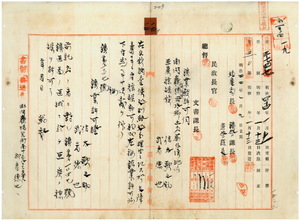
The files of the Taiwan Government-General record that on 1 November 1911 he and 武者徳也 were granted permission to mine lignite in the Penghu district.9
 (opens in a new tab)
「信太歌之助外一名鑛業願許可ノ件」, 1911. National Taiwan Historica (臺灣文獻館), via the Taiwan Cultural Memory Bank, licensed CC BY-NC 3.0 TW (opens in a new tab).
In Taiwan, in his last years, he taught Kawashima Takashi. Namiki Yasushi (並木靖), eighteenth in his line of Jikishinkage-ryū, writes in Ken no kokoro: Katsu Kaishū to Jikishinkage-ryū (剣のこころ — 勝海舟と直心影流; “The Heart of the Sword: Katsu Kaishū and Jikishinkage-ryū”):
直心影流十六代川島堯は、台湾で晩年の信太歌之助に師事していた。
Kawashima Takashi, sixteenth of Jikishinkage-ryū, studied in Taiwan under Shida Utanosuke in Shida’s last years.10
Namiki goes on, as the essay quotes him, with a story of the two. Kawashima asked, 「柳生流に伝わる手刀とはどういう剣ですか」: what kind of sword is the 手刀 (hand-sword) handed down in the Yagyū school? Shida began to explain, stopped, and said, “No, let me show you. Bring a short blade and some paper.” He made a tube about two sun across from Mino paper, pasted the edge, stood it on the table and cut it through on the diagonal with Kawashima’s prized Bizen Nagayoshi short sword. It looked simple. Kawashima went to his room and tried the same with the same paper and the same blade, and could not cut it: too fast, and the tube was crushed; too slow, and it fell over.7
Namiki also gives Shida’s verdict on himself:
余も以前、幕末から維新の頃、止むを得ないこととはいいながら、度々殺人刀を振い同じ日本人を切った。その為、技術上の上手にはなったが、真の名人にはなれないで一生を終わるだろう。これに反し、義兄弟の山岡鉄舟は、あの動乱の時代に一度も刀を抜くことなく、名人として生涯を送った。
In the years from the end of the shogunate to the Restoration I, too, though it could not be helped, often wielded the killing sword and cut down fellow Japanese. That made me skilled in technique, but I shall end my life without becoming a true master. My sworn brother Yamaoka Tesshū, by contrast, never once drew his sword in those turbulent times, and lived his life as a master.7
A Taiwanese account, which this record has not yet traced to its source, says that he came to Taiwan at about eighty, in the Taishō era, at Kawashima’s invitation, lived with him and taught swordsmanship at the Tainan Butokuden, and died in Taiwan in the fifth month of Taishō 6 (1917). The 1911 mining licence shows he was already in Taiwan some years earlier.
The Taiwan kyūdō timeline gives the same man as Aoyagi Kumakichi / Shida Utanosuke (青柳熊吉/信太歌之助), and records Kawashima travelling to Hualien Port to receive him in 1916. The dates suggest, though no source says so, that it was after Shida’s death that Kawashima sought out Yamada Jirōkichi in Japan to continue in Jikishinkage-ryū.
What Has Been Written About Him
A reference inquiry answered by Narita City Library in 2023 gathered the works that mention him, under either name.1 Among them:
- general references: Bakumatsu ishin dai-jinmei jiten (幕末維新大人名事典), vol. 1, pp. 626–627, and Sakamoto Ryōma dai-jiten (坂本竜馬大事典), p. 162;
- local histories of the Bōsō peninsula: the Chiba prefectural history (千葉県の歴史 通史編近現代1), pp. 51–53, and the Isumi town history (夷隅町史 通史編), pp. 459 and 569, both under his post 総房三州鎮静方; the Chōshi city history (銚子市史, 1956), in its chronology, pp. 1134–1135; and the Yokoshiba town history (横芝町史, 1975), pp. 543–544, which tells an episode involving him and Kawashima Takashi;
- Meiji papers: the catalogue of the Mishima Michitsune papers (三島通庸関係文書目録), pp. 83, 106 and 144, and the Meiji kenpakusho shūsei (明治建白書集成), vol. 6;
- an autobiography, Shida Utanosuke jiden (信太歌之助自傳);
- the Jikishinkage-ryū literature: Namiki’s Ken no kokoro and Katsu Kaishū no genten: jikishin no ken no satori (勝海舟の原点 直心の剣の悟り);
- and the two books used above, Honchō kyōkaku den and Sakamoto Ryōma genkōroku.
The library also flags two works it could not check, Kyūdō kaikoroku: Heki-ryū Sekka-ha no yumi (弓道回顧録 日置流雪荷派の弓) and Boshin nairanki no shakai (戊辰内乱期の社会). The first is a book on the same Sekka-ha archery that Kawashima practised.
End Notes
-
Narita City Library (成田市立図書館), reference inquiry DR20231000010, 2 November 2023, in the National Diet Library’s Collaborative Reference Database: https://crd.ndl.go.jp/reference/detail?page=ref_view&id=1000343467 (opens in a new tab). The question describes him as 「銚子出身の剣客で槍の名手と言われる」 (a swordsman from Chōshi said to be a master of the spear); the answer lists the works under “What Has Been Written About Him”, with page numbers and links to digitized copies. The Ōkura newsletter is Kōhō Ōkura (広報おおくら) no. 758, October 2022, p. 17. ↩ ↩2 ↩3
-
Honchō kyōkaku den (本朝侠客伝), ed. 酔多道士 (Kōkikaku, Meiji 20 = 1887), entry 「信太歌之介」, pp. 124–146: https://dl.ndl.go.jp/pid/778727/1/78 (opens in a new tab) (pp. 124–125) to https://dl.ndl.go.jp/pid/778727/1/89 (opens in a new tab) (p. 146); the 1868 arrest and prison at https://dl.ndl.go.jp/pid/778727/1/83 (opens in a new tab) and https://dl.ndl.go.jp/pid/778727/1/84 (opens in a new tab) (pp. 134–137), the Great Buddha at https://dl.ndl.go.jp/pid/778727/1/85 (opens in a new tab) (pp. 138–139), his Meiji ventures at https://dl.ndl.go.jp/pid/778727/1/86 (opens in a new tab) (p. 140), and his 1883 petition (歎願趣意書) at pp. 141–146 (koma 86–89). The drawing is on plate 17, https://dl.ndl.go.jp/pid/778727/1/14 (opens in a new tab). A collection of lives of “chivalrous men”, written while he was alive; it reads as a celebration, and its dates do not always agree (it has him reach Kōfu in the first month of 1864, before the Tsukuba rising it says he fled). It goes on to his later pacification work in Kazusa, including an affair with robbers at Yokoshiba station. ↩ ↩2 ↩3 ↩4 ↩5 ↩6 ↩7 ↩8 ↩9 ↩10 ↩11 ↩12 ↩13 ↩14 ↩15 ↩16
-
Watanabe Shūjirō (渡辺修二郎), ed., Sakamoto Ryōma genkōroku (坂本竜馬言行録; Naigai Shuppan Kyōkai, Taishō 2 = 1913), section 「龍馬と柔術家青柳熊吉」, pp. 20–25: https://dl.ndl.go.jp/pid/952868/1/17 (opens in a new tab) to https://dl.ndl.go.jp/pid/952868/1/19 (opens in a new tab). It prints the anecdote, then says that Shida, “now over seventy and engaged in mining”, had told the story himself somewhat differently and in more detail, and gives his account in his own words. ↩ ↩2 ↩3 ↩4 ↩5 ↩6
-
Shidankai (史談会), ed., Kokuji ōshō hōkō shishi jinmeiroku (国事鞅掌報効志士人名録), vol. 1 (Imazu Ryūji, Meiji 42–44 = 1909–1911), entry 「信太歌之助」 (舊稱青柳熊吉), pp. 353–354: https://dl.ndl.go.jp/pid/780216/1/229 (opens in a new tab), continued at https://dl.ndl.go.jp/pid/780216/1/230 (opens in a new tab). A register of men who served the nation at the Restoration, compiled by the society that collected participants’ testimony; it describes him as alive. ↩ ↩2 ↩3 ↩4 ↩5 ↩6 ↩7
-
Komiyama Nanryō (小宮山昌玄), Nanryō nenroku (南梁年録), vol. 36, manuscript (小宮山叢書), National Diet Library: https://dl.ndl.go.jp/pid/2577061/1/45 (opens in a new tab) to https://dl.ndl.go.jp/pid/2577061/1/46 (opens in a new tab). The petition is copied in a running hand; the names here follow the library’s machine reading checked against the page, the heading is only partly legible to the machine reading, and the year is inferred from the envoy’s journey east in Bunkyū 2 (1862). Read it as a lead to be confirmed. ↩
-
Ōtsuka Takematsu and Fujii Jintarō, eds., Kawaji Toshiakira monjo (川路聖謨文書), vol. 7 (Nihon Shiseki Kyōkai, 1934): https://dl.ndl.go.jp/pid/1920561/1/198 (opens in a new tab). 「靑柳熊吉之所置近來不承快絕也かく有たし元來切捨もの也」. The affair itself is not named. ↩
-
山高 (masata01), 「総房三州鎮静方 信太歌之助という男」, note, 8 October 2023, https://note.com/masata01/n/nf25c24977c04 (opens in a new tab). The essay came to Shida through a quotation from Namiki’s book while researching Yamaoka Tesshū, and reads his 1868 movements from Katsu Kaishū’s diary. ↩ ↩2 ↩3
-
Zoku Tokugawa jikki (続徳川実紀), part 5, 「慶喜公御實紀」, Meiji 1, third month, third day, printed p. 1694: https://dl.ndl.go.jp/pid/773009/1/851 (opens in a new tab). The day’s summary lists the order as 「爲房總鎭靜方取締廻村令」. ↩
-
「信太歌之助外一名鑛業願許可ノ件」 (item 14: 信太歌之助ト武者徳也ヘ澎湖庁管内ノ亜炭鉱採掘願許可ノ件), 16 October – 1 November 1911, Taiwan Government-General files, National Taiwan Historica (臺灣文獻館), via the Taiwan Cultural Memory Bank, CC BY-NC 3.0 TW: https://tcmb.culture.tw/zh-tw/detail?indexCode=CultureMemory_FC&id=00001852014 (opens in a new tab). ↩
-
Namiki Yasushi, Ken no kokoro: Katsu Kaishū to Jikishinkage-ryū (剣のこころ — 勝海舟と直心影流; Suzuran Shobō, 1979). The sentence is quoted in the essay in the next note; the page in Namiki’s book (National Diet Library, https://dl.ndl.go.jp/pid/12150314/1/120 (opens in a new tab), restricted access) has not been checked here. ↩